Nvidia Deep Dive
The Sovereign Engine of the Intelligence Age

On October 23, 2024, in a high-security facility in Copenhagen, Jensen Huang and King Frederik X of Denmark plugged in a new era of global power. With a single command, the Gefion AI Supercomputer hummed to life, representing not the reach of a Silicon Valley cloud giant, but the digital independence of an entire nation. This was the birth of Sovereign AI, where Nvidia’s ‘Muscle’ provided the forge for a country to reclaim its own data, culture, and future.
Powered by thousands of Nvidia’s liquid-cooled super-chips, Gefion is the spark that sent shockwaves through the market: Nvidia’s “Muscle” paired with Palantir’s “Logic.”
As Nvidia’s silicon began churning through trillions of calculations, Palantir’s operating system was already there, translating raw compute into immediate breakthroughs in life sciences and green energy. For the first time, a nation-state decoupled its future from the cloud, proving that the world’s most valuable commodity is no longer oil, it is Sovereign Intelligence.
This historic activation marks the “Big Bang” of the Sovereign AI era. It confirms that Nvidia is no longer just selling to corporations; they are providing the fundamental infrastructure of 21st-century statehood. To understand why the global economy is being re-written in Nvidia Green, we must look back at the man who saw this coming thirty years ago in a Denny’s diner.
Welcome to the Sovereign Engine of the Intelligence Age.
Origin Story: The Prophets of the Parallel Universe
In 1993, the future of computing was being sketched on the back of a paper napkin at a Denny’s in East San Jose. Seated in a booth that has since become a landmark of American innovation, Jensen Huang, Chris Malachowsky, and Curtis Priem gathered to architect a world that didn’t yet exist.
Jensen, who had previously worked as a dishwasher at that very same chain, brought a unique spirit of humility and hospitality to the table. He understood that to serve the world, one must first be willing to do the hard work that no one else wants to do. At that time, the industry was obsessed with the Central Processing Unit (CPU), the “brain” of the computer that solved problems one step at a time. But Jensen and his co-founders possessed a prophetic understanding of Moore’s Law. They saw a looming ceiling where traditional serial processing would eventually fail the soaring demands of human imagination.
They called their venture ‘NV’ (Next Version). When they eventually looked for a name, they landed on the Latin word Invidia (envy). It was a bold, almost mythic choice for a company that set out to build the tools of the future before the world even knew how to ask for them.
Their vision focused on solving the most punishing computational riddle of the era: 3D graphics. While others saw video games as a mere pastime, Jensen saw a gateway to a new dimension of mathematics. He realized that simulating reality required a fundamentally different architecture, one that could handle thousands of tiny, simultaneous calculations at once. This was the birth of Parallel Processing.
By choosing to master the GPU (Graphics Processing Unit), they were effectively building a time machine. They were betting that the same math required to render a blade of grass in a video game would one day be the same math required to map the human genome, predict the weather, and eventually, give birth to artificial intelligence.
Nvidia anticipated the very moment when the world would outgrow the CPU, quietly preparing the foundation for a civilization that would soon run entirely on accelerated light and logic. This Denny’s booth was the forge where the modern world was first imagined, long before the first spark of silicon was ever struck.
History
The path to global dominance began with a near-total collapse. Nvidia’s first attempt at a chip, the NV1, arrived at the market stillborn. It was technically ambitious but commercially ignored. By 1996, the dream born in a Denny’s booth was failing; the company sat just weeks away from bankruptcy.
In a move of sheer audacity, Jensen Huang flew to Japan to meet with the CEO of Sega. He admitted that Nvidia’s technology had veered down the wrong path, yet he asked for a $5 million lifeline to keep the company alive. Sega’s leadership saw something in Jensen’s conviction that transcended the balance sheet. They wrote the check. That $5 million from a video game company became the most important investment in the history of modern computing, buying Nvidia the time to pivot and engineer the RIVA 128. Launched with only one month of payroll remaining, the RIVA 128 saved Nvidia from the brink of collapse by selling over one million units in just four months to gamers and hardware partners like Diamond Multimedia as the industry’s first high-performance, integrated 2D and 3D graphics accelerator.

By 1999, Nvidia achieved what many thought impossible: they defined a new category of technology. They released the GeForce 256 and branded it the world’s first GPU (Graphics Processing Unit). This single piece of silicon changed the trajectory of human entertainment, bringing cinematic realism to the masses.
Video Game Consoles Powered by Nvidia:
The Original Xbox (2001): The aforementioned breakthrough led directly to Microsoft choosing Nvidia to build the NV2A, the custom heart of the original Xbox. It was a watershed moment that moved consoles away from specialized, “black box” hardware and onto the powerful parallel-processing architecture Nvidia had pioneered.
The PlayStation 3 (2006): The lineage of the GPU continued with the RSX Reality Synthesizer. Co-developed with Sony and based on the high-end GeForce 7 series, this chip brought high-definition, cinematic gaming to millions of living rooms, solidifying Nvidia as the architect of the modern console era.
The Nintendo Switch (Released 2017): Nintendo made the bold choice to move away from traditional console architecture to partner with Nvidia. The Switch is powered by a custom Nvidia Tegra X1 processor.
Nintendo Switch 2 (2025) The Custom T239 “Drake” processor, a generational leap featuring dedicated RT and Tensor Cores for AI-driven DLSS 3.1 and 4K output.
But Jensen’s mind was already decades ahead.
In 2006, he made a decision that looked like corporate suicide to everyone else. He launched Compute Unified Device Architecture (CUDA), a software platform that allowed the GPU to solve complex mathematical problems far beyond the world of gaming. For nearly ten years, Wall Street hammered the stock, questioning why Nvidia was pouring billions of dollars into a platform with no apparent customers. Analysts saw a “science project” while Jensen saw the infrastructure of a new civilization.
Gannon Capital Internal Thoughts:
Jensen was thinking in decades while Wall Street was focused on quarterly earnings targets. He spent a decade building something that apparently nobody wanted, knowing that one day the titans of industry would fight over who could write him the biggest check just to be first in line. These are the opportunities I seek in each of my investment picks.
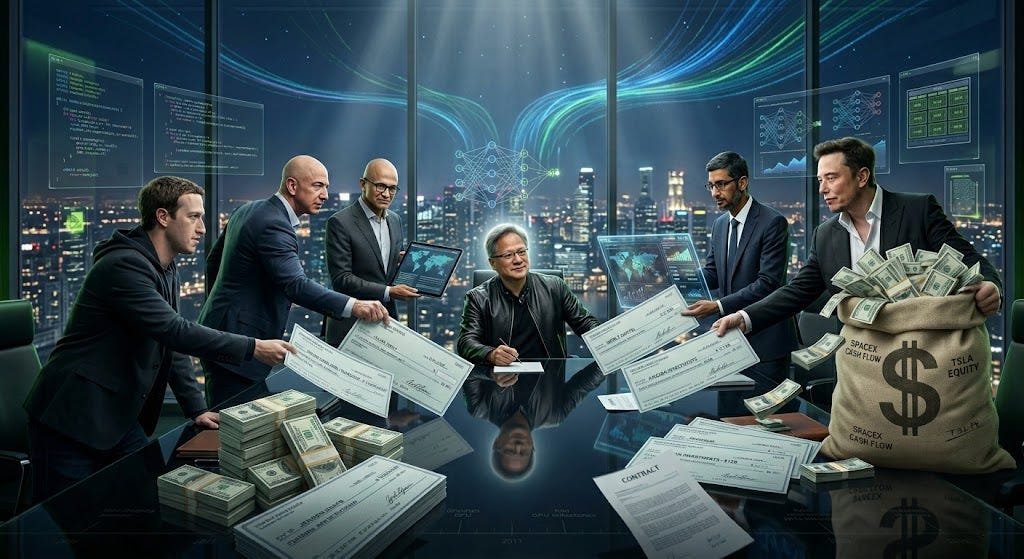
Nvidia’s time finally arrived in 2012 with the “Big Bang of AI.” A research project called AlexNet used two Nvidia GPUs to shatter all previous records in image recognition, proving that the parallel processing Jensen had championed for twenty years was the secret key to artificial intelligence. In a single moment, the world realized that Nvidia hadn’t just been making toys for gamers, they had been forging the engines of the future. The tools were ready before the world even knew how to ask for them.
Fun Fact: A $5,000 investment in Nvidia at this time would now be worth over $2 million [over 400x]
The Digital Gold Rush: A Prelude to Intelligence
While Wall Street remained skeptical of CUDA, the world began to discover the GPU’s hidden potential in an entirely unexpected way. In the late 2000s, the birth of Bitcoin and decentralized finance triggered a global “Digital Gold Rush.”
Cryptocurrency miners, searching for a way to solve the complex mathematical riddles required to secure the blockchain, realized that the traditional CPU was far too slow for the task. They looked to Nvidia and discovered that Jensen’s parallel processing architecture could solve these cryptographic puzzles with a speed and efficiency that bordered on the miraculous.
This era served as the ultimate stress test for Nvidia’s vision. For the first time, the world saw the GPU not just as a tool for rendering art, but as a master engine for calculating value. It was a profound realization: Jensen had accidentally created the most efficient way to turn raw electricity into a digital asset. This period of “accidental” success was the first signal that the GPU was destined to be the foundational layer of the 21st-century economy, a precursor to the moment when that same power would be used to forge intelligence itself.
Gannon Capital Internal Thoughts: Below are the series of events that helped me secure my position in Nvidia at an average price of $3.34.
Sometime in the mid-2010s: I discovered The Motley Fool stock advisor newsletter. I was intrigued by their track record of absolutely crushing the S&P 500, specifically their early Amazon and Netflix picks.
Early 2018: This is where I saw their Nvidia recommendation and put the company on my watch list. After researching the company and seeing how they pivoted from a “gaming chip company” to a “Bitcoin mining company” I remember thinking to myself “they will probably be able to do other great things too.” If only I knew then how massive these “other great things” would have been, I would have bought a ton more.
Late 2018: I began to notice a pattern in Bitcoin’s price (the 4-year cycle) and saw Nvidia’s stock tanking in late December 2018, dragged down by “crypto winter”. I had recently received my Christmas bonus and decided that this would be a great opportunity to put some of this money to work. As it turns out, I was right.
The Business: Architecting the Infinite
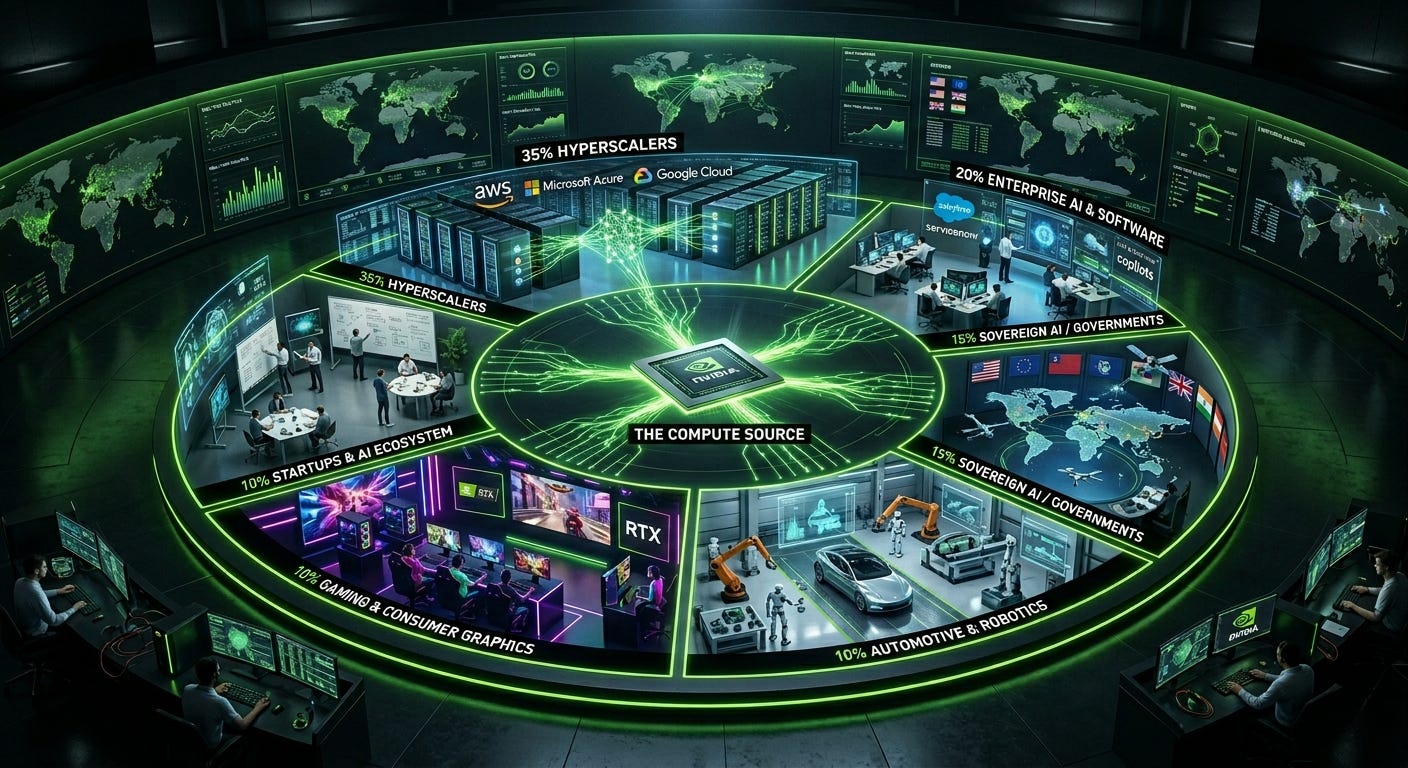
Jensen Huang’s greatest insight was realizing that the world would eventually demand a computer so powerful it could no longer fit on a single piece of silicon. He spent decades preparing for this shift, evolving Nvidia from a supplier of parts into a Full-Stack Systems Company, the master architect of the most complex machines ever built by man.
The AI Factory: Jensen has reimagined the very nature of the computer. Today, Nvidia delivers the AI Factory, the colossal infrastructure of the modern age. Through the Blackwell and Rubin architectures, they assemble integrated marvels like the NVL72. These are liquid-cooled, interconnected racks that function as a singular, gargantuan “super-chip.” These factories allow entire industries to generate intelligence at a scale previously reserved for the pages of science fiction.
Networking (The Mellanox Advantage): In the quest for accelerated computing, the ultimate challenge is the speed of light itself. By integrating Mellanox (the AI’s nervous system) into their DNA, Nvidia gained mastery over the InfiniBand and Spectrum-X protocols. They own the “glue”, the sophisticated networking that allows tens of thousands of GPUs to communicate as one. This ensures that the flow of data is as instantaneous as a human thought, removing the bottlenecks that once slowed the progress of global discovery.
Software (NIMs & CUDA): The true magic of Nvidia lives in the soul of the machine. Through Compute Unified Device Architecture (CUDA) and the introduction of NVIDIA NIMs (Inference Microservices), they have built the Operating System for AI. These tools allow developers to breathe life into their models with breathtaking speed. By providing a turnkey environment where complexity is abstracted away, Nvidia has created a digital sanctuary so intuitive that it has become the universal language of the intelligence age. Once an innovator enters this ecosystem, they find a level of harmony that makes the rest of the world feel obsolete.
The Thesis
Jensen Huang’s mastery and even conquest of Moore’s Law has led to a profound realization: we are witnessing the dawn of a new Industrial Revolution. Just as the 19th century was defined by the steam engine turning coal into physical power, the 21st century is defined by Nvidia turning electricity into intelligence.
The Generative Shift: For decades, the digital world operated on “retrieval”, we searched for information that already existed. Today, we have entered the “Generative Era.” Through Nvidia’s architecture, the world now creates entirely new ideas, images, and solutions in real-time. This is the Industrialization of Intelligence, where the “token” is the new unit of economic value, and Nvidia is the greatest entity on Earth for producing it at a global scale.
The Rise of Sovereign AI: In a stunning geopolitical shift, nation-states have realized that their data is their most precious natural resource. Countries like Japan, the UK, the UAE, and Denmark are now building their own “National AI Factories” to safeguard their culture and intelligence. What was a nascent idea only two years ago has blossomed into a $30 Billion annual revenue stream, as every government on Earth rushes to secure its place in the intelligence age using Nvidia as the foundation.
Agentic & Physical AI: The next chapter of this story moves from the digital screen into the physical world. Through the Isaac and Cosmos platforms, Nvidia is creating the “brain” for the world’s autonomous fleets. They are building the Omniverse, a digital twin of our entire reality where robots can learn to navigate the physical world before they ever touch the ground. This transition into “Physical AI” ensures that Nvidia will be the foundry for every autonomous machine, from factory arms to self-driving cars.
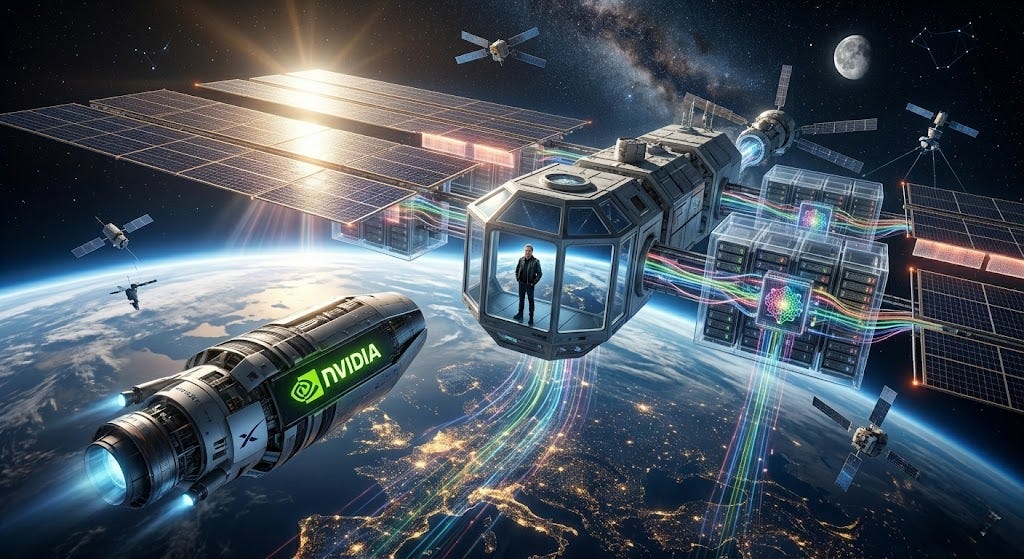
The Final Frontier (Space-Based Computing): Jensen’s vision now extends beyond the confines of our atmosphere. As the demand for compute reaches astronomical levels, Nvidia is looking toward the stars to solve the challenges of energy and cooling. By pioneering the concept of Space Data Centers, they are preparing to harness the infinite solar energy and the natural vacuum of orbit. This orbital intelligence layer will serve as a galactic relay, providing the compute power necessary for a multi-planetary civilization, ensuring that Nvidia’s “Next Version” is literally universal.
Gannon Capital Internal Thoughts:
The relationship between Jensen Huang and Elon Musk is a decades-long alliance of two prophets who realized, long before the rest of the world, that the future of civilization would be written in code and powered by silicon.
The Digital Heart (2010–2012): Their synergy began when Jensen provided the “digital heart” for the Tesla Model S. By powering Tesla’s revolutionary 17-inch touchscreen with Nvidia’s Tegra processors, they effectively turned the automobile into the world’s first mobile supercomputer.
The Prophetic Gift (2016): In a moment that has since become legend, Jensen hand-delivered the world’s first AI supercomputer, the DGX-1, directly to Elon’s hands at the original OpenAI headquarters. Jensen signed the chassis with a blessing: “To Elon and the OpenAI team! To the future of computing and humanity!” It was a shared realization that the era of “General Intelligence” had finally arrived.
The Infrastructure of Ambition (2024–2026): Today, that partnership has scaled into the stratosphere. Elon’s xAI has constructed “Colossus,” the most powerful AI training cluster on Earth, built entirely on the backbone of 100,000 Nvidia GPUs. While Tesla has moved to design its own specialized chips for the “Edge,” Elon remains one of Jensen’s most vital partners in the quest for Physical AI, using Nvidia’s massive clusters to train the “brains” of the Optimus humanoid robot and the SpaceX Starship fleet.
Together, they represent the ultimate synthesis of human progress: Elon provides the Grand Ambition to reach the stars and automate the world, while Jensen provides the Unstoppable Muscle required to make it a reality. They are the two architects of the Intelligence Age, building the “Next Version” of humanity in tandem.
The Competition: The Race to Catch the Future
As the world awakens to the reality that accelerated computing is the new bedrock of civilization, every major power in technology is racing to build their own version of what Jensen Huang envisioned decades ago. Yet, in their rush to catch up, they are discovering that Nvidia had built an entirely new way of thinking that is proving nearly impossible to replicate.
The Titans of the Cloud (Hyperscalers): The giants of the industry, Google with their Tensor Processing Unit (TPU), Amazon with Trainium, and Meta with Meta Training and Inference Accelerator (MTIA), are investing billions to forge their own custom silicon. These “internal Nvidias” are impressive feats of engineering, designed to optimize their specific workloads. However, these are specialized instruments built for narrow purposes. Nvidia remains the Universal Language. While a custom chip might solve one specific riddle, Nvidia’s architecture remains a vast, general-purpose canvas that allows researchers to invent the future without being boxed in by the limitations of their hardware.
The Legacy Challengers (AMD & Intel): Traditional rivals like AMD, with their MI300/400 series, have finally produced hardware that can stand in the same arena as Nvidia’s silicon. It is a testament to the sheer scale of the opportunity that these storied companies are pivoting their entire futures toward AI. But they are finding that hardware is only half the battle and are currently facing a twenty-year software deficit as I explained in my AMD Deep Dive back in February. Jensen’s decision to launch CUDA in 2006 created a generational lead in developer trust and community wisdom. Trying to replace Nvidia today is like trying to replace the English language; even if you invent a “better” one, everyone is already speaking the original.
The Speed Seekers (Niche Innovators): A new wave of brilliant startups, such as Groq and Etched, have emerged with a singular focus: raw speed. They are building chips designed for ultra-fast “inference”, the moment an AI actually thinks and responds. These machines are breathtaking in their specialized velocity, but they lack the massive ecosystem and the relentless, compounding scale of the Blackwell and Rubin roadmaps. While these startups capture specific flashes of lightning, Nvidia is the hurricane, providing a seamless path from the first spark of an idea to its global deployment.
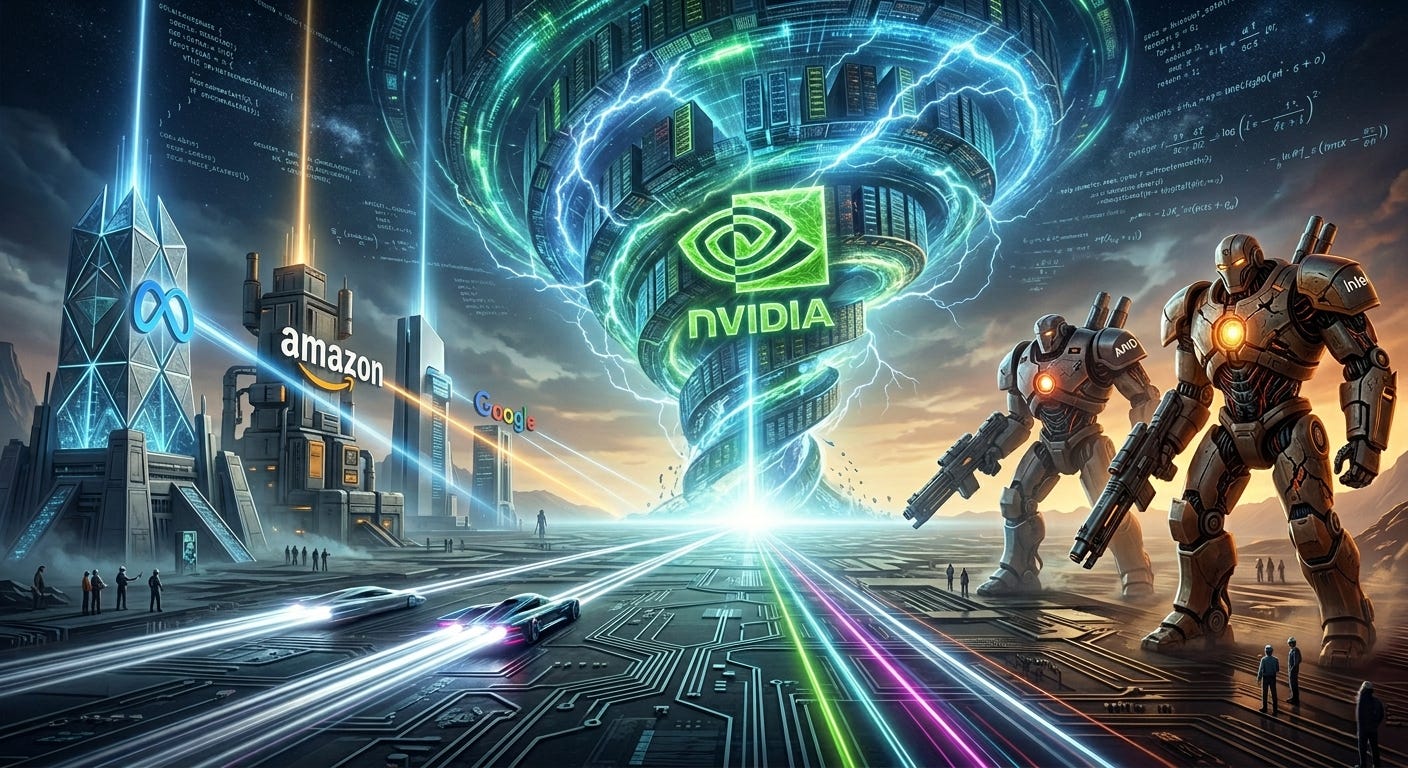
The competition is no longer just about who can make the best chip; it is a race to see who can build a future as expansive as the one Jensen Huang began sketching in that San Jose booth thirty years ago. So far, the world is still living in Nvidia’s imagination.
The Moat: A Fortress Built of Light and Logic
Nvidia’s dominance is not merely a result of making a better chip; it is the result of Jensen Huang spending thirty years building a multi-layered defense system that surrounds the future of computing. It is a “Wide Moat” in the truest sense; a series of interlocking advantages that make competing against Nvidia feel like trying to rewrite the laws of physics.
CUDA: The Language of Creation (The Software Fortress): Jensen’s greatest prophecy was realizing that hardware is useless without a soul. Launched in 2006, CUDA has become the universal language of artificial intelligence. With over 5 million developers and 19 years of accumulated libraries (like cuDNN and NCCL), CUDA is the bedrock upon which every major AI breakthrough, from AlexNet to ChatGPT, was built. For a developer to leave Nvidia is to abandon two decades of wisdom, toolsets, and community support. It is a “Time Moat” that cannot be bought with any amount of capital.
The Interconnect: The Speed of Thought (The Networking Moat): In the age of giant AI models, the bottleneck is no longer the individual chip, it is the speed at which chips talk to each other. Through the acquisition of Mellanox, Nvidia seized control of the “glue” that holds the modern world together. Technologies like NVLink and InfiniBand allow tens of thousands of GPUs to function as a single, massive brain. While others sell “components,” Nvidia sells a “nervous system” that moves data at speeds that defy conventional networking, ensuring their clusters are always more than the sum of their parts.
The Supply Chain Stranglehold (The Physical Moat): In a world of finite resources, Nvidia has secured the high ground. By booking over half of TSMC’s advanced CoWoS (Chip-on-Wafer-on-Substrate) capacity through 2027, Jensen has effectively cornered the market on the very machines required to build high-end AI. This created a physical bottleneck that makes their competition weak in the knees. Even if a competitor designs a perfect chip, they may find there is no factory left on Earth with the capacity to print it.
The AI Factory: From Chips to Systems (The Vertical Moat): Nvidia has moved beyond the “chip vendor” model to become the architect of the AI Factory. They don’t just deliver silicon; they deliver the NVL72, a fully integrated, liquid-cooled rack that functions as a singular supercomputer. By controlling the chip, the rack, the cooling, the networking, and the software, Nvidia achieves extreme co-design. This vertical integration allows them to find efficiencies that disparate systems, built from parts from five different companies, simply cannot match.
The One-Year Rhythm (The Speed Moat): Jensen has shattered the traditional “Tick-Tock” cycle of the semiconductor industry. While rivals struggle to match the Hopper architecture, Nvidia has already moved to Blackwell, with Rubin and Feynman visible on the horizon. By shifting to a one-year release cadence, effectively transcended Moore’s Law, Nvidia has turned themselves into a moving target in hyperspace. By the time a competitor catches up to where Nvidia was, Nvidia has already redefined where the world is going.
The Sovereign Trust (The Geopolitical Moat): As nation-states like Japan, the UAE, and the UK rush to build “Sovereign AI,” they are not looking for the cheapest chip; they are looking for the most reliable foundation for their national security. Nvidia has become the “Central Bank of Compute,” a trusted partner for governments that cannot afford to bet their future on unproven ecosystems. This creates a $30B+ revenue stream that is largely insulated from the traditional booms and busts of the tech cycle.
The Efficiency of the Infinite (The Energy Moat): In the coming age, the primary constraint on human progress will be electricity. Jensen’s “prophetic understanding” led to the Blackwell and Rubin architectures, which deliver up to 10x better performance-per-watt than previous generations. By making intelligence cheaper and more energy-efficient, Nvidia is selling the only viable path to a sustainable future. They have turned energy efficiency into an economic weapon that makes any rival “bargain” look like an expensive mistake.
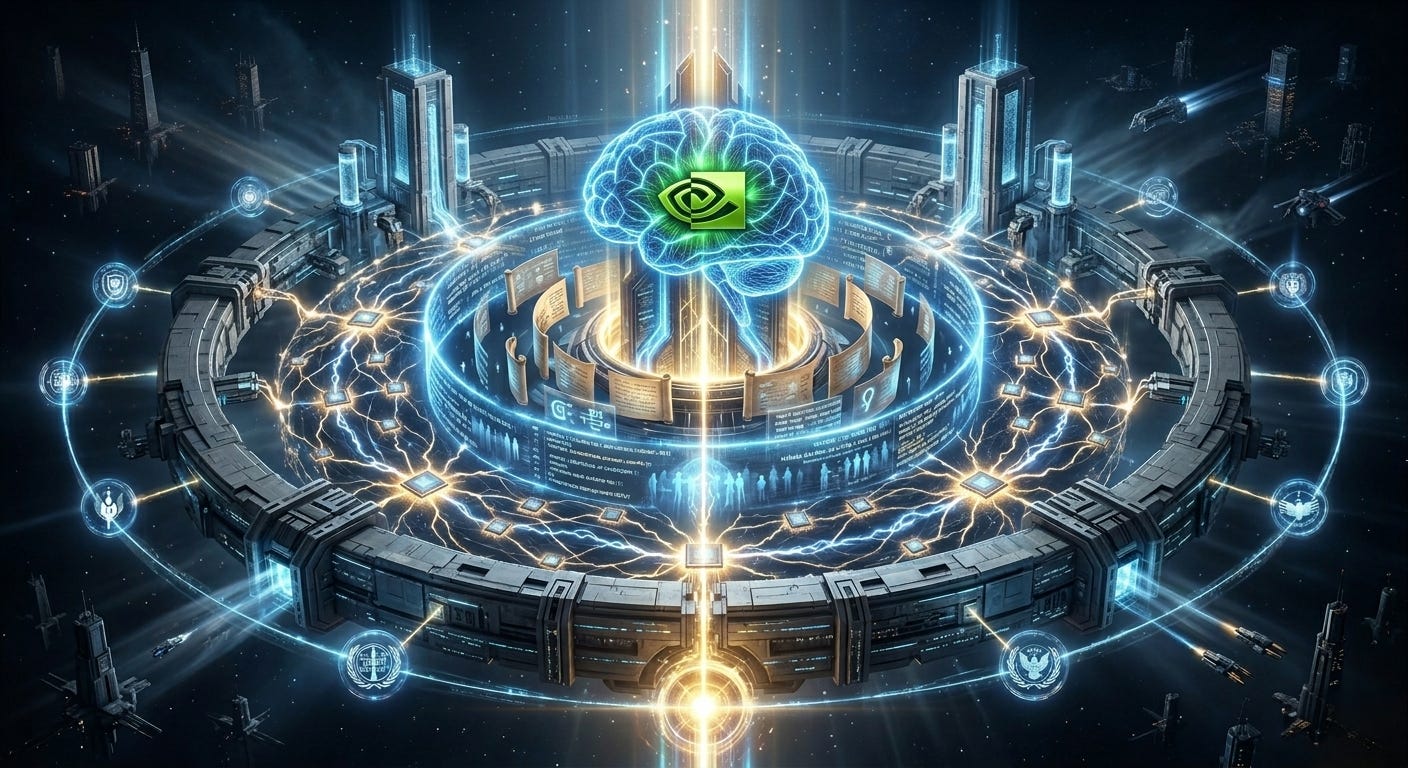
Strategic Partnerships & Alliances: The Architecture of Global Synergy
Jensen Huang has often remarked that the “Next Version” of the world cannot be built by one company alone. He has spent decades cultivating a web of alliances so profound that Nvidia has become the common denominator of every major technological breakthrough. By positioning Nvidia as the foundational layer, Jensen has turned his biggest potential rivals into his most vital partners, ensuring that every road to the future leads through his silicon.
The Cloud Trinity (Microsoft, Google, and Amazon): The three giants of the cloud have entered a state of “co-opetition” that defines the modern era. While they forge their own internal chips, they remain the largest architects of Nvidia’s expansion.
Microsoft has become the vanguard of this movement, constructing the “Fairwater” AI Superfactories, massive, multi-state complexes powered by hundreds of thousands of Blackwell Ultra GPUs. Together, they are even using the Omniverse to simulate the construction of nuclear power plants, creating a self-sustaining loop of energy and intelligence.
Amazon (AWS) is preparing for a future of unprecedented scale, with plans to deploy more than 1 million Nvidia GPUs across their global regions. They are integrating the “Inference Xfer Library” (NIXL) to ensure that the “thinking” speed of their AI matches the speed of a human conversation.
Google Cloud is championing flexibility, integrating Nvidia Dynamo with their Kubernetes engine to allow the world’s developers to sculpt AI with the precision of a master artist.
The Oracle Nexus: In the quest for Sovereign AI, Oracle has become Nvidia’s most critical bridge to the world’s governments. Through Oracle’s Distributed Cloud and OCI Dedicated Regions, they are building “National AI Factories” that live entirely within a country’s borders. This partnership allows nations like the UAE to protect their cultural data while wielding the full power of the Blackwell architecture. Furthermore, they are collaborating with the U.S. Department of Energy to build Solstice, a supercomputer at Argonne National Laboratory featuring 100,000 Blackwell GPUs, designed to solve the greatest scientific mysteries of our time.
The Meta Marriage: Mark Zuckerberg and Jensen Huang have forged a multi-generational alliance centered on the vision of “Personal Superintelligence.” Meta has committed to a staggering deployment of millions of Blackwell and Rubin GPUs, making it one of the largest single infrastructure investments in human history. This partnership goes beyond simple compute; it is a fundamental redesign of the data center, where Nvidia’s Grace CPUs and Spectrum-X networking serve as the heart and soul of Meta’s quest to give every human on Earth a personalized AI companion.
The Elon Connection (Tesla & xAI): The synergy between Jensen’s “brain” and Elon Musk’s “machines” is reshaping the physical world. Tesla continues to train the future of autonomy, both in cars and the Optimus humanoid, on massive Nvidia-powered clusters. Meanwhile, xAI is pushing the boundaries of the possible with the Colossus supercomputer, a monument to human ambition that uses over half a million Nvidia GPUs to seek an understanding of the true nature of the universe.
The Apple & Foxconn Synthesis: While Apple remains the master of the “Edge,” Nvidia provides the power that fuels their ecosystem behind the scenes. Foxconn, the primary assembler of the iPhone, has become Nvidia’s lead manufacturer for AI racks, building a $1.4 billion supercomputing center that will be the forge for the next generation of consumer devices. From high-performance workstations that connect directly to the Apple Vision Pro to the servers that train the next wave of “Apple Intelligence,” the two companies are quietly stitching together the fabric of our daily lives.
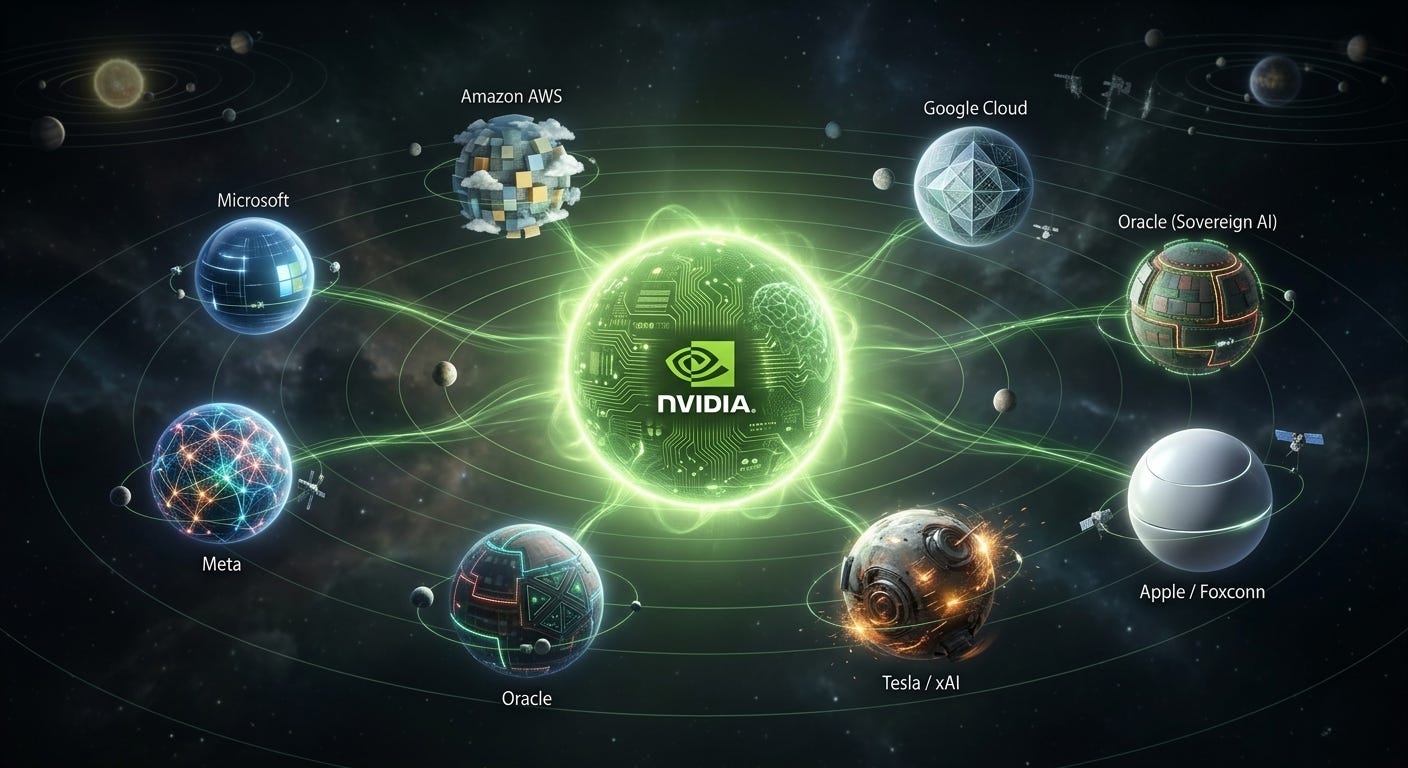
These are the tectonic plates of the new world shifting into place. By making Nvidia’s technology the universal standard, Jensen has ensured that the “Next Version” of civilization is an open-source collaboration between the greatest minds of our century.
The Numbers: The Single Greatest Print in History
In the spring of 2026, Nvidia delivered what market historians are now calling the single greatest earnings print in the history of corporate capitalism. It was a moment where the sheer scale of the “AI Industrial Revolution” became undeniable, proving that Jensen Huang had successfully turned a semiconductor company into the most profitable infrastructure engine ever conceived.
The $216 Billion Juggernaut: Nvidia concluded Fiscal Year 2026 with a staggering $215.9 Billion in revenue, representing a 65% jump year-over-year. To put this in perspective, Nvidia added more revenue in a single year than the entire market capitalization of most Fortune 500 companies. This growth is a testament to a world that has transitioned from “buying chips” to “building factories.”
Data Center Dominance: The “Nervous System” of the business has reached its final form. The Data Center segment now represents 90% of total revenue. This shift highlights Nvidia’s successful pivot from a gaming-adjacent hardware vendor to the primary architect of the global cloud. Every major hyperscaler and nation-state is now effectively a tenant in the house that Jensen built.
The Profitability Miracle: Perhaps the most “wondrous” aspect of the report was the $120.1 billion in GAAP Net Income. Producing twelve-digit profits while navigating the complex transition to the Blackwell architecture is a feat of operational excellence. Even more miraculous is the 75.2% Gross Margin. Maintaining software-level margins on the world’s most complex physical machines, liquid-cooled, interconnected supercomputer racks, defies every known law of traditional manufacturing.
The Rule of 40 (The Golden Standard Shattered): In the world of high-growth technology, a “Rule of 40” score (Growth + Margin) of 40% is considered elite. Nvidia has moved beyond elite into a category of its own:
Last Quarter (Historical): With 65% revenue growth and a 40% Free Cash Flow margin, Nvidia posted a Rule of 40 score of 105%.
Forward Projection: Even as the law of large numbers begins to apply, Nvidia’s guidance suggests a Forward Rule of 40 score of 85% (projecting 45% growth and 40% FCF margins). This suggests that the efficiency of the “Nvidia Engine” is not a temporary spike, but a permanent state of high-velocity output.
Free Cash Flow & The Buyback Engine: Nvidia generated a monumental $85.4 in free cash flow, allowing them to return $41.1 billion to shareholders through buybacks, signaling Jensen’s supreme confidence that the “Next Version” of the company is still undervalued.
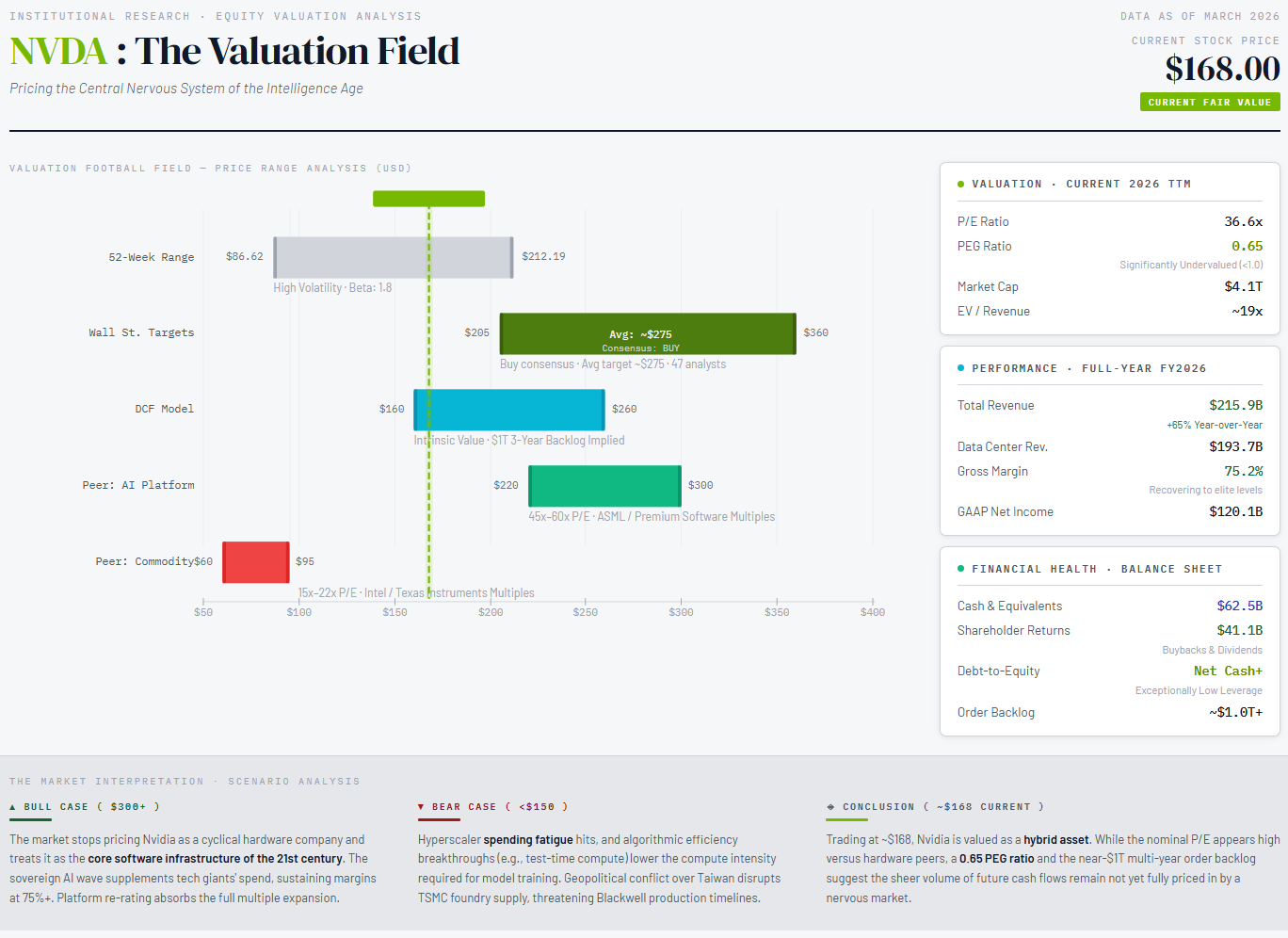
Forward Guidance & The Valuation Paradox: Despite the massive run in share price, the numbers tell a story of a company that is still growing into its suit. Trading at a Forward P/E of 36.6x, Nvidia remains remarkably attractive when paired with its 0.65 PEG Ratio. In a world where the “Central Bank of Compute” is guiding for a $1 trillion multi-year backlog, a 36x multiple for a company doubling its earnings is a rare anomaly in financial history.
Valuation & Risks: The Price of the Future
To value Nvidia is to value the speed of human progress itself. Jensen Huang has built a company that defies traditional financial gravity, but as Nvidia becomes the foundational pillar of the global economy, it also becomes the lightning rod for the world’s most complex challenges.
The “Capex Cliff” & The ROI Riddle: The primary bear case centers on the sheer scale of the “Industrial Revolution.” In 2026, the Big Five hyperscalers, Microsoft, Meta, Alphabet, Amazon, and Oracle, are projected to spend a staggering $650 billion+ on AI capex. Critics fear a “Capex Cliff”, the moment these giants might stop buying if they don’t see immediate software ROI. Yet, Jensen views this as the “largest infrastructure buildout in human history,” noting that every GPU ever sold is already being rented. With the emergence of Agentic AI, where autonomous software agents perform complex labor, the ROI is shifting from “experimental” to “essential,” suggesting that the cliff may actually be a plateau into a much larger valley of growth.
The Taiwan Constraint (The Existential Risk): Nvidia’s greatest strength is also its most delicate vulnerability. Over 90% of the world’s advanced chips are forged on a single island. The “Taiwan Constraint” is the ultimate Black Swan; any geopolitical friction in the Taiwan Strait threatens not only Nvidia, but it also threatens to stall the modern world. In early 2026, concerns have shifted toward energy security, as Taiwan’s reliance on imported natural gas makes its high-intensity “AI Factories” vulnerable to maritime disruptions. While Nvidia is diversifying with new facilities in Arizona, the “silicon heartbeat” of the company remains inextricably linked to the peace and stability of the Asia Pacific.
Regulatory & Geopolitical Friction: As Nvidia’s chips become as strategic as oil, they have entered the crosshairs of global regulators. Recent investigations into foundry-level export controls and high-profile “smuggling schemes” involving dummy servers highlight the difficulty of controlling the most valuable commodity on Earth. Nvidia must now navigate a world where its technology is a “proxy for global peace,” balancing the demands of national security with the borderless nature of scientific innovation.
Valuation: The Central Bank of Compute: How do you price a monopoly on intelligence? While trading at a forward P/E that fluctuates between 20x and 43x, Nvidia often appears “expensive” to the untrained eye. However, when viewed through the lens of the PEG Ratio (currently 0.65), a different story emerges. Nvidia is actually “cheap” relative to its triple-digit growth. It is being valued not as a cyclical hardware company, but as the Central Bank of Compute, the entity that prints the currency of the 21st century. To bet against this valuation is to bet that the world will suddenly decide it needs less intelligence tomorrow than it does today.
Gannon Capital Internal Thoughts: The Choice of a Generation
Nvidia is no longer just a stock in a portfolio; it is a wager on the future of our species. Jensen Huang has built the forge where the next version of reality is being hammered into shape. From the dishwasher at Denny’s to the architect of a $4 trillion empire, his journey reminds us that the greatest dishes are often cooked up by those who see what the world wants to eat before it even knows it’s hungry.
As Palantir provides the Logic to govern the new world, Nvidia provides the Muscle to build it. We are living in the “Nvidia Era,” and the only question left for an investor is whether they want to be a spectator or a shareholder in the industrialization of thought.
Final Thoughts: The Sovereign Architect of a New Reality
Nvidia has transcended the definition of a semiconductor company. It has evolved into a Macro Asset, the singular, undeniable index for the 21st-century industrial revolution. If the previous century was built on the back of the combustion engine and the flow of oil, the next thousand years will be built on the back of accelerated computing and the flow of tokens.
