ServiceNow Deep Dive
The Control Tower of the Agentic AI Economy

The enterprise software market is currently caught in a violent disconnect between visionary potential and brutal market sentiment. On one hand, Nvidia CEO Jensen Huang recently shook the industry at GTC 2026, declaring that the next trillion dollars of value will not go to hardware alone, but to the agentic software companies charging monthly subscriptions for AI employees. On the other hand, the market seems to have lost its nerve as ServiceNow, the undisputed king of enterprise workflow, was recently trading down a staggering 60% from its late 2024 highs near $225. The "Saaspocalypse" has created a rare historical anomaly: the company best positioned to act as the central nervous system for the $15 trillion agentic economy is being priced as if it is a relic of the past.
Origin Story: The Phoenix of Silicon Valley
In 2003, Fred Luddy was at a breaking point. As the CTO of Peregrine Systems, he watched as a massive accounting scandal, one he was not involved in, erased his $100 million net worth overnight and sent his company into bankruptcy. Most people in their late 40s would have retreated or taken a safe advisory role. Instead, Luddy moved into a modest home and, on his 50th birthday, sat down at his kitchen table to write the first line of code for what would become ServiceNow.
His motivation wasn’t revenge; it was empathy. For decades, Luddy had watched office workers struggle with soul-crushing software, clunky, beige interfaces that felt like digital prison. He famously said his vision was to “build a platform that allows regular people to route work through an enterprise as easily as they do in their personal lives.” He didn’t want to build a better database; he wanted to build a “Lego set for work” that would give power back to the frustrated employee.
History
The Kitchen Table Prototype (2003–2004)
When Fred Luddy’s previous world imploded at Peregrine Systems, he lost his title, his fortune, and his professional identity. At 50, in an industry obsessed with “young disruptors,” Fred was considered a relic. But Fred had a secret weapon: Observation.
He had spent decades watching how people actually worked, and he realized that the biggest tax on human productivity was friction. He didn’t just want to build a better software tool; he wanted to build a “workflow engine” that was as simple as a child’s toy but as powerful as a supercomputer. He spent a year alone at his kitchen table, coding with a singular focus:
The work should find the person, not the person finding the work.
The “No-Venture” Years
Early on, Fred’s vision was met with laughter. VCs told him that “the browser is too slow” and that “corporations will never trust the cloud.” He had no marketing budget and no fancy office. In those early years, the company survived on resilience. Fred and his small team, including his brother Rob, focused on making their first customers obsessively successful.
Their idea was to sell relief instead of software.
When an IT manager used ServiceNow for the first time, the empathy in the code was obvious. It was the first enterprise tool that didn’t feel like it was designed by someone who hated the user. This bottom-up love from the IT department created a cult-like following that eventually forced CEOs to take notice.
The Era of “The Great Orchestrator”
As the company grew, it faced its next test: Scope. Legacy giants like BMC and CA Technologies tried to crush them. ServiceNow survived by refusing to stay in its lane.
Focus: They realized that if you could track an IT ticket, you could track a “request for a new desk” or “a legal contract review.”
The Transition: Under the leadership of Bill McDermott, the company shifted from being a “Help Desk Company” to the “Platform of Platforms.”
ServiceNow became the “connective tissue” for the world’s fragmented digital empires. They didn’t try to replace Salesforce or Workday; they became the Great Orchestrator that lived above them.
The Result: A Humble Giant
Today, ServiceNow sits at the center of the Global 2000, but that “Fred Luddy DNA” remains. The company’s resilience is etched into its 98% renewal rate and estimated 120% Net Revenue Retention. These are a numbers that can only be achieved when your customers feel that the software was built by someone who actually understood their pain.
The Full Circle: Today, as the market panics over AI, ServiceNow looks back at its own history. They have survived the death of the mainframe, the birth of the cloud, and the “SaaSpocalypse” of early 2026. Their resilience is built on the fact that while technology changes, the human need for simple, frictionless work is eternal.
The Business: What They Do
To understand ServiceNow’s business, you have to stop thinking about it as software and start thinking about it as the Enterprise Nervous System. Most large companies are a mess of digital silos; HR uses one system, Finance uses another, and IT uses a third. When an employee needs something, they are forced to act as a human bridge between these departments, wasting hours in “email hell.”
ServiceNow takes that unstructured chaos and turns it into a single, automated track for work to run on.
Solving the Soul-Crushing Pain Points
ServiceNow targets the hidden taxes on an employee’s day:
The “Swivel Chair” Tax: Having to log into several systems just to change a mailing address or request a leave of absence.
The “Status Update” Black Hole: Sending an email to “HR@company.com” and waiting three days just to find out if anyone has even seen your request.
The “Manual Handoff” Crisis: When a manager approves a new hire, but the IT team doesn’t get the message, so the employee sits idle for their first week without a computer.
The Real-World Impact: Who Loves the Product?
ServiceNow isn’t just used by tech companies; it’s the backbone for the world’s most complex organizations.
1. Coca-Cola Europacific Partners (CCEP)
The Pain: With thousands of field technicians across Europe and the Pacific, managing equipment repairs and customer orders was a nightmare of manual spreadsheets.
The ServiceNow Solution: They used Customer Workflows to automate their entire supply chain and field service. Now, when a vending machine in a remote corner of Australia breaks, a “self-healing” workflow automatically notifies the technician, orders the parts, and updates the customer, all without a single phone call or email. CCEP has reported a massive increase in employee satisfaction because the tech just works.
2. St. Jude Children’s Research Hospital
The Pain: In a high-stakes medical research environment, doctors and scientists shouldn’t be wasting time figuring out how to request new lab equipment or reporting a broken printer.
The ServiceNow Solution: St. Jude used the Now Platform to create a one-stop shop for everything. Whether a researcher needs a new microscope or a legal contract reviewed, they go to one portal. By removing the administrative friction, ServiceNow effectively gives time back to the people trying to cure catastrophic childhood diseases.
The Four Pillars of the “Now Platform”
IT Workflows: The Foundational Layer. It ensures the servers stay up, the laptops are secure, and the cybersecurity threats are neutralized before a human even knows they exist.
Employee Workflows: The Culture Layer. It transforms the onboarding nightmare into a “Welcome Home” experience, managing everything from payroll setup to desk assignments.
Customer Workflows: The Revenue Layer. It connects the front office (sales) to the back office (operations), so when a customer has a problem, the person on the phone actually has the power to fix it.
Creator Workflows: The Innovation Layer. It allows a non-technical employee, like a store manager or a nurse, to build their own “low-code” apps to solve local problems, without waiting for the IT department to do it for them.
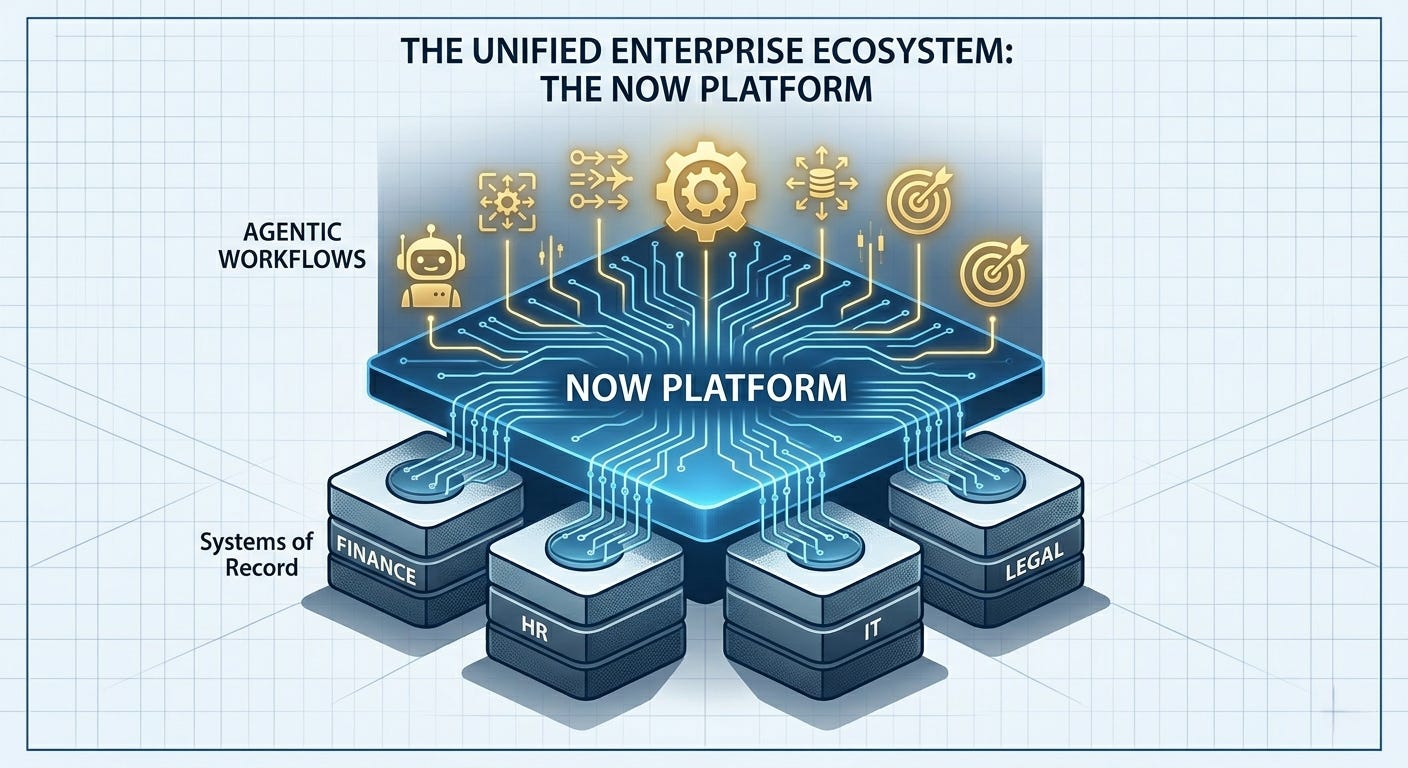
Gannon Capital Internal Thoughts: This is why the Agentic AI shift is so powerful here. If an AI agent wants to help a St. Jude researcher order a new lab tool, it doesn't have to learn how to navigate 50 different legacy systems. It just talks to the Now Platform, which already has the map and permission to get the job done.
The Thesis: The Agentic Supercharger
The fundamental bull case for ServiceNow is simple: Generative AI provides the brain, but ServiceNow provides the body.
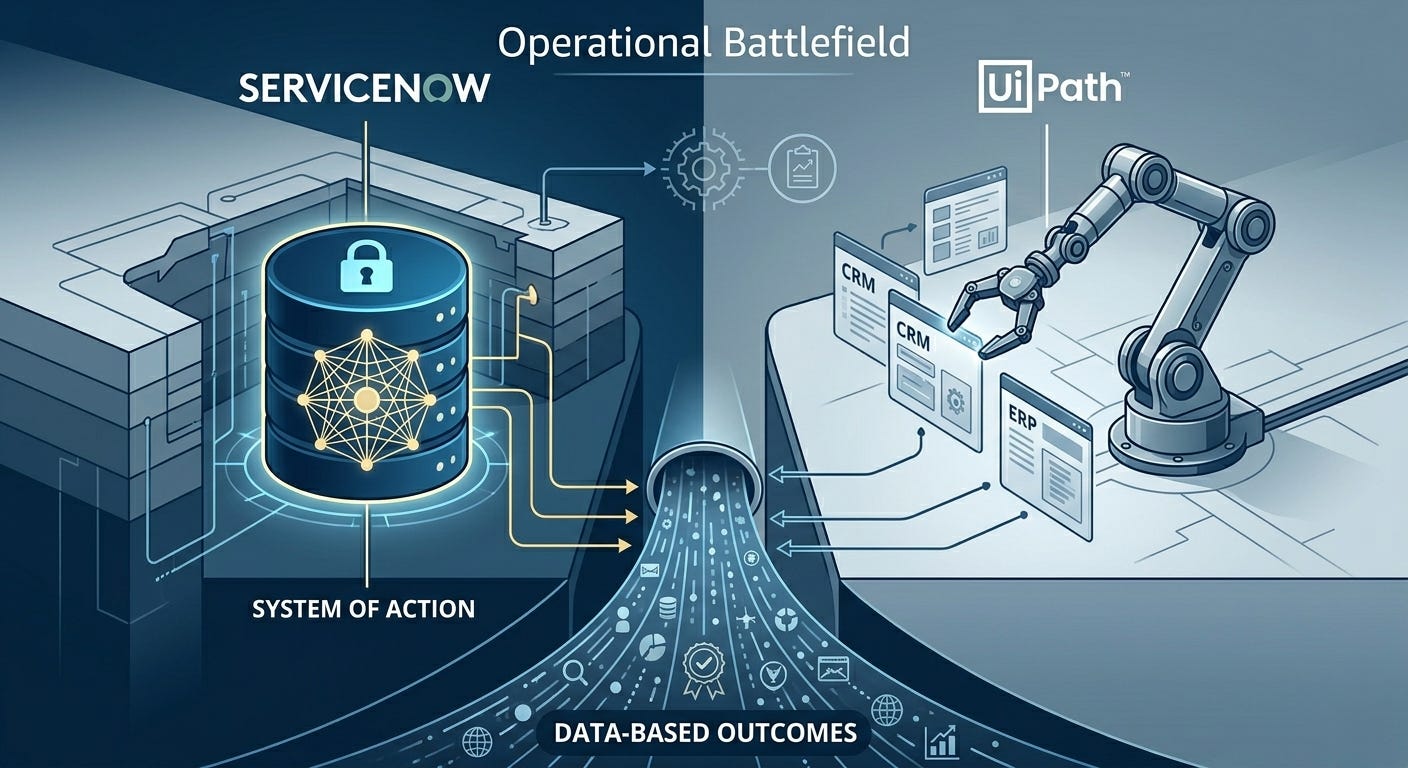
An LLM can write a brilliant email about a supply chain delay, but it cannot log into a legacy ERP, verify a contract, message a vendor, and update a billing cycle. ServiceNow can. By serving as the “System of Action” that sits on top of every other “System of Record,” ServiceNow is the only platform that can turn AI’s intent into a business result.
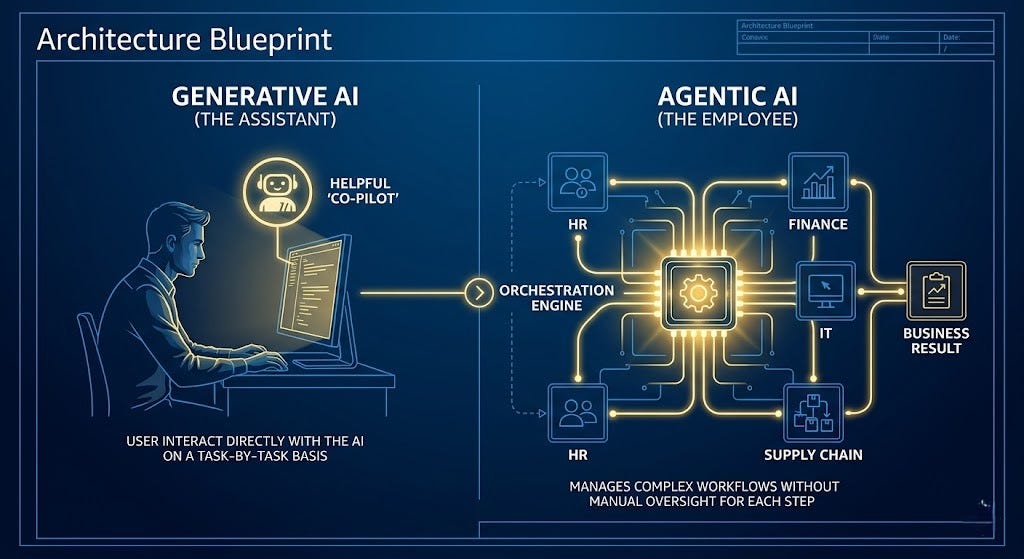
The 10x Multiplier: Why Agentic > Generative
I believe strongly that the transition from Generative AI to Agentic AI will be one of the largest shifts in economic value that we’ve ever seen.
The Generative Economy (The Assistant): Focuses on individual productivity. It’s a tool that helps a human work faster. Current estimates place this market at roughly $500B–$1T in global impact.
The Agentic Economy (The Employee): Focuses on autonomous outcomes. These are “Digital Workers” that handle entire processes from start to finish.
Industry forecasts for 2026 suggest the Agentic AI economy will be 10x to 15x larger than the Generative market, potentially contributing over $20 trillion to global GDP by 2030.
The Supercharger Effect
ServiceNow is uniquely positioned to benefit from this new economy through three primary levers:
The AI Control Tower: As companies deploy thousands of agents (from Microsoft, Nvidia, and internal teams), they need a central “Air Traffic Control” to ensure they aren’t hallucinating or breaking compliance. ServiceNow’s AI Control Tower is becoming the industry standard for governing these digital workers.
Killing the Seat Tax: The market’s biggest fear, that AI will reduce human employees (seats), is actually ServiceNow’s greatest opportunity. They are aggressively shifting to Value-Based Pricing. They don’t want $100 for a “user license”; they want a cut of the $10,000 in value an autonomous agent creates by resolving a complex issue in seconds.
The Context Advantage: To work, an agent needs context. Because ServiceNow already houses a company’s IT, HR, and Customer data, it provides the “Golden Dataset” that makes AI agents actually intelligent. Without ServiceNow, an agent is just a genius alone in a room without a phone. With ServiceNow, it has the keys to the entire building.
Gannon Capital Internal Thoughts:
I see the current 60% selloff is a classic “Forest for the Trees” error. Investors are selling because they fear a world with fewer human seats, failing to realize that ServiceNow is the very platform that will host, manage, and monetize the millions of digital agents that will fill those roles.
The Competition: Battle for the Enterprise Brain
The Legacy Incumbents (The “Displaceable” Guard)
BMC Software, Ivanti, & Broadcom (CA): These are ServiceNow’s oldest rivals. While they still hold significant market share in legacy data centers, they are largely seen as defensive plays. They struggle to match ServiceNow’s unified cloud architecture, making them the primary source of customer churn that ServiceNow feeds on.
The Horizontal Challengers (The Silo Specialists)
Salesforce: A formidable foe. Salesforce owns the front office (Sales/Marketing). While they are pushing hard into “Agentforce,” their DNA is built around customer data. ServiceNow’s DNA is built around internal operations. The battle here is over who becomes the “Single Pane of Glass” for the employee.
Atlassian (Jira): Dominant in the developer world. However, Atlassian often struggles to move from the engineering basement to the HR/Finance boardroom where ServiceNow lives.
The “Pure-Play” AI Challengers (The High-Stakes Rivalry)
This is where the battle for the Agentic Economy is actually being fought.
Palantir (AIP): Palantir is ServiceNow’s most intellectual competitor. While ServiceNow is a System of Action, Palantir is a System of Decision.
The Conflict: Palantir’s AIP (Artificial Intelligence Platform) is world-class at taking massive, messy datasets and helping CEOs make high-level decisions.
The ServiceNow Edge: Palantir tells you what to do; ServiceNow actually does it. Most enterprises find Palantir harder to implement across every single employee, whereas ServiceNow is already installed in the daily workflow of the rank-and-file.
UiPath: Once known for simple bots (RPA), UiPath has evolved into an Agentic Automation powerhouse.
The Conflict: UiPath specializes in recording what a human does and automating it. They are fighting to be the “hands” of the AI agent.
The ServiceNow Edge: UiPath often sits on top of the screen, mimicking human clicks. ServiceNow lives inside the infrastructure. When an API or a server changes, UiPath’s bots can break; ServiceNow’s native workflows remain resilient because they are the system.
The “Frenemy” (The Ecosystem Giant)
Microsoft: Microsoft is ServiceNow’s largest partner and its most looming threat. With Copilot and Power Apps, Microsoft could theoretically build everything ServiceNow offers.
The “Switzerland” Advantage: Most enterprises use a mix of AWS, Google Cloud, and Oracle. They don’t want to be locked in to a Microsoft-only world. ServiceNow acts as a neutral third party (The Switzerland of Tech) that can orchestrate work across all these clouds.
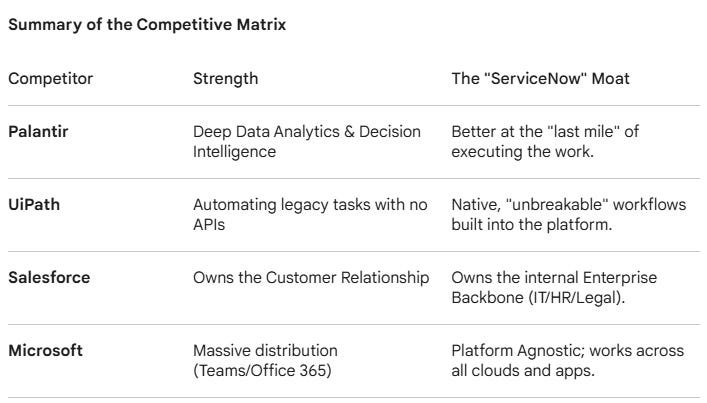
Gannon Capital Internal Thoughts: The Agentic AI race isn't winner-take-all. Palantir will almost certainly win on intelligence, while ServiceNow is the most likely winner of execution. The biggest risk to ServiceNow isn't a single competitor; it's the speed at which these silos are being dissolved by AI itself.
The Moat: The Unassailable Enterprise Core
A software company can have incredible features, but without a moat, it will eventually be commoditized. ServiceNow’s moat is both wide and deeply structural, woven directly into the operational physics of the modern corporation.
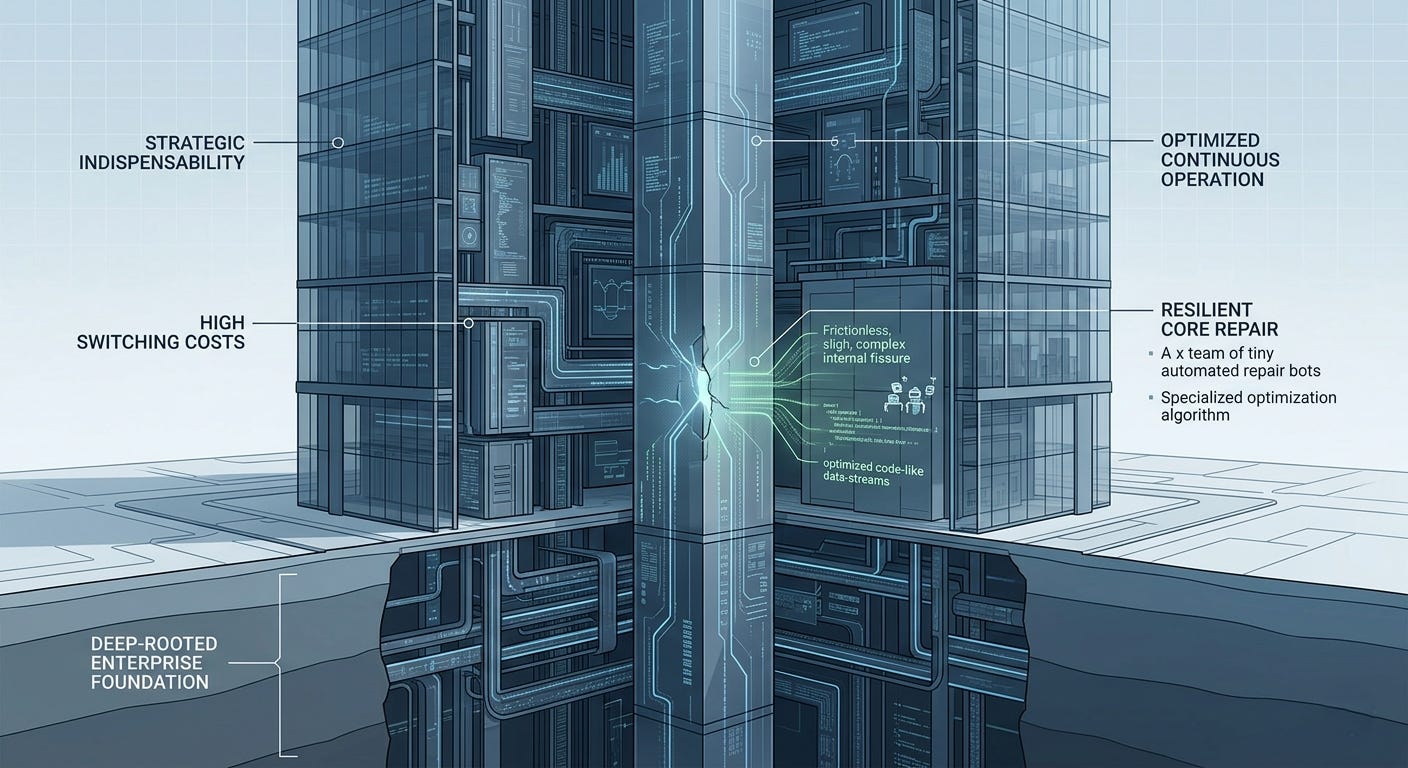
High Switching Costs: The “Open-Heart Surgery” Effect
Once an enterprise configures its custom business workflows on the Now Platform, ripping it out is often a catastrophic operational risk.
The Depth of Integration: ServiceNow connects to legacy ERPs, local databases, HR platforms, and cloud infrastructure. It governs the rules of engagement for how work moves.
The Practical Reality: Replacing ServiceNow requires mapping thousands of highly specific, institutional processes that have been refined over a decade. Attempting to rip it out is equivalent to performing open-heart surgery on a patient while they are running a marathon. The risk of operational downtime far outweighs any potential savings from a cheaper competitor.
Internal Network Effects: The Horizontal Gravity
Most software suffers from diminishing returns as it expands, but ServiceNow experiences Internal Network Effects driven by its Common Service Data Model (CSDM).
The Footprint Cycle: A company typically buys ServiceNow to fix its IT help desk. But once IT is on the platform, HR realizes they can use the same engine to handle employee onboarding requests. Then Legal realizes they can use it to track contract approvals.
The Gravity: The more departments that join the platform, the more valuable the data asset becomes to the central IT and executive teams. It creates a unified truth layer that breaks down corporate silos. By the time a company realizes how deeply embedded ServiceNow is, the platform has become the standard language of the entire enterprise.
The Holy Grail: A Single Codebase Powered by RaptorDB
Unlike Salesforce, Oracle, or Microsoft, who scaled their empires by acquiring disjointed software companies and sewing them together like Frankenstein’s monster, ServiceNow grew organically from a single codebase.
The Architectural Moat: Every module ServiceNow offers (IT, HR, Customer, Legal) shares the same data model, the same UI framework, and the same underlying security architecture.
The RaptorDB Advantage: To future-proof this single codebase for the AI era, ServiceNow migrated its backend infrastructure to RaptorDB (a highly optimized HTAP database architecture). RaptorDB processes live transactional data and complex AI analytics simultaneously on the same engine, eliminating the need for messy, delayed data pipelines Extract, Transform, Load (ETL) workflows.
The Modern Moat Verdict: While competitors spend billions trying to get their acquired AI tools to talk to their acquired database tools, ServiceNow customers can deploy an AI agent that instantly inherits the security, governance, and real-time data context of the entire enterprise on day one.
Gannon Capital Internal Thoughts: The Future of the Agentic AI Economy
As we look toward 2030, the traditional definition of software is dying. We are transitioning from an era where humans use software to complete tasks, to an era where software acts as an autonomous workforce.
Traditional SaaS: Human interacts with individual apps to do work.
Agentic Economy: AI Agents orchestrate across apps to deliver outcomes.
The Shift from “Co-Pilot” to “Manager”
The market currently views AI through the lens of the “Co-Pilot” a helpful assistant waiting for human commands. This view is fundamentally limited. The future belongs to autonomous agents that proactively hunt down anomalies, reroute supply chains, and self-heal infrastructure.
However, an economy populated by millions of independent AI agents introduces a terrifying new problem: Chaos!
Automation Without Governance is Just a Faster Way to Fail
If a company deploys thousands of independent agents from different vendors (Microsoft, Google, OpenAI, internal builds), who coordinates them? Who ensures an agent doesn’t accidentally approve an illegal trade, leak customer data, or conflict with another agent’s logic?
This is where ServiceNow wins the ultimate prize. Through its newly launched AI Control Tower and Agent Studio, ServiceNow is positioning itself as the HR Department and Compliance Officer for AI Agents.
The Ultimate Conclusion
The future of the agentic economy will not be won by the company with the flashiest LLM. It will be won by the platform that provides the Guardrails, Traceability, and Action Fabric.
ServiceNow doesn’t need to build the smartest AI brain in the world; it just needs to remain the undisputed System of Action. Because at the end of the day, an intelligent agent without a workflow engine is just a brain without hands. ServiceNow is the only company that owns the hands of the modern enterprise.
Strategic Partnerships & Alliances
The Big Four: The Implementation Armies
ServiceNow scales through massive alliances with the Big Four Accounting Firms: Deloitte, KPMG, PwC, and EY. These consulting giants have built multi-billion-dollar practice groups solely dedicated to integrating ServiceNow into the Global 2000. They act as outsourced implementation armies, highly incentivized to embed the platform deeply within corporate operations because it drives lucrative, multi-year digital transformation consulting contracts for their own firms.
The Hyperscalers: Cloud Orchestration, Not Competition
Rather than spending tens of billions of dollars to build out raw data center infrastructure to compete with Microsoft Azure, AWS, and Google Cloud, ServiceNow has turned the hyperscalers into its closest allies. The platform acts as the objective, multi-cloud orchestration layer. When a massive enterprise needs to provision resources, monitor system health, or manage cybersecurity workflows across mixed cloud environments, they run it seamlessly through a single pane of glass on the Now Platform.
NVIDIA: The Brain Meets the Body
The alliance with NVIDIA is the most architecturally profound partnership in enterprise tech today, specifically built to handle the macro transition to autonomous operations.
Knowledge 2026 Keynote: Jensen Huang took the stage with CEO Bill McDermott to showcase custom enterprise autonomous AI agents (such as the “Otto” agent built for FedEx) that doesn’t just make recommendations but actually executes multi-step workflows autonomously.
The Accretive Reality: Huang directly refuted the “Saaspocalypse” narrative, stating that Agentic AI is completely accretive for enterprise software companies. Because the broader enterprise service industry is roughly 100x larger than the software market alone, ServiceNow’s total addressable market expands exponentially when it transitions from selling human seat licenses to billing for autonomous outcomes.
Gannon Capital Internal Thoughts: Sovereign AI and the Ultimate Validation
The 60% drawdown from the late-2024 highs has created a spectacular structural disconnect between panicked short-term equity markets and the highest levels of tech and political validation. While Wall Street has spent months pricing ServiceNow like a vulnerable legacy software play destined to lose revenue to human seat shrinkage, the literal architects of the macro economy are quietly taking the opposite side of the trade.
Look closely at the disclosures and geopolitical optics breaking right now in May 2026:
The Federal Backstop: Under the administration’s AI Action Plan, the U.S. General Services Administration (GSA) recently executed a massive “OneGov” modernization agreement with ServiceNow to power AI-first automation across the federal government, targeting a projected 30% boost in workflow efficiencies.
Personal Note: If there’s one industry in the world that I could choose to be completely overhauled and replaced by AI, it is government bureaucracy. This excites me on a deeply personal level.
The OGE Disclosures: President Trump’s latest OGE Form 278-T financial disclosure forms revealed massive first-quarter portfolio positioning. While trimming legacy tech positions, the filings show substantial new multi-million dollar entries ($1M to $5M bracket) specifically targeting semiconductor infrastructure and elite enterprise software leaders, headlined by ServiceNow ($NOW).
The Beijing Jet: Just this past week, top tech executives accompanied the President on a high-stakes trade and tech sovereignty mission to Beijing. Among the inner circle was the CEO Trump publicly lauded on Truth Social as “the Great Jensen Huang.”
The fundamental investment signal here is undeniable. The market is panicking over a temporary multiple compression, while the world’s dominant hardware monopoly and the highest executive offices in Washington are building an infrastructure ecosystem that relies on ServiceNow as the central enterprise engine.
At its current 52-week low near $81.24, you are front-running the literal sovereign backbone of the agentic economy.
This video below features Nvidia CEO Jensen Huang explaining why the enterprise application layer is poised to capture massive financial upside from the shift to autonomous, outcome-based AI agents.
The Numbers
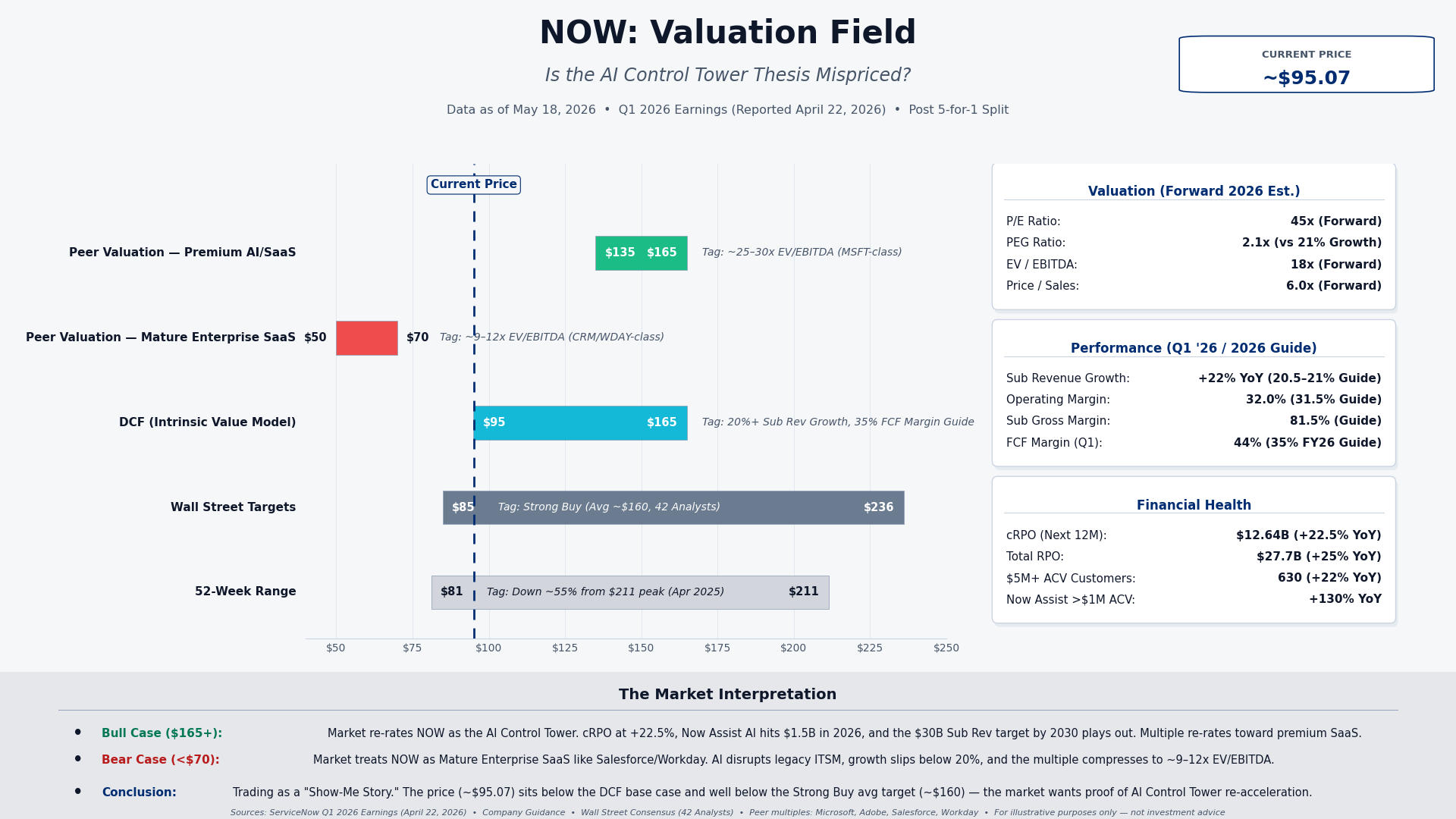
While Wall Street celebrates SaaS companies that manage to scrape past the elite “Rule of 40,” ServiceNow has graduated into its own league. Combining its 22% Year-over-Year subscription revenue growth with its stellar 32% Non-GAAP operating margin (or its massive 44% Free Cash Flow margin), ServiceNow operates as a Rule of 55+ business. In Q1 2026 alone, the company generated $1.67 billion in Free Cash Flow, proving it can fund its massive agentic AI infrastructure rollout completely out of organic cash generation.
Revenue: The Unbroken 20%+ Trajectory
Q1 2026 Realities: Total revenue hit $3.77 billion, driven by $3.67 billion in pure subscription revenues, representing 22% Year-over-Year growth (19% in constant currency).
The Visibility Runway: The most critical forward-looking metric, Current Remaining Performance Obligations (cRPO), contract revenue scheduled to be recognized over the next 12 months, stands at a towering $12.64 billion (up 22.5% YoY). Total RPO reached $27.7 billion (up 25% YoY), providing ServiceNow with a multi-year, highly predictable revenue cushion that younger competitors simply do not have.
Subscription Model: 97% Recurring Dominance
Out of its $3.77 billion in quarterly revenue, an astronomical 97.4% is purely recurring subscription revenue. Professional services make up a negligible fraction of the business. This means ServiceNow’s top-line engine remains entirely insulated from cyclical IT consulting pullbacks or transaction-based volatility.
Retention: The Ultimate Institutional Lock-In
The 98% Renewal Bedrock: ServiceNow maintains an industry-leading 98% renewal rate. This number completely defuses the “Saaspocalypse” narrative of massive seat shrinkage. Enterprises are not abandoning or optimizing away their ServiceNow footprints; if anything, the core infrastructure has become as non-negotiable as a corporate utility tax.
Customer Tier: Hyper-Scaling the Elite Bracket
Rather than chasing low-margin volume, ServiceNow’s growth engine is focused squarely on capturing high-ACV (Annual Contract Value) enterprise spend within the Global 2000.
The $5M+ Club: ServiceNow ended Q1 2026 with 630 customers spending more than $5 million annually, charting a steady 22% YoY increase.
Metric to Watch: Large-contract velocity is actively accelerating. The company closed 16 net-new transactions over $5 million in Q1 alone, representing a massive 80% year-over-year growth in that elite cohort.
The AI Monetization Proof: The financial proof of their premium AI monetization is explicitly visible. The number of enterprise customers spending over $1 million in ACV specifically on Now Assist AI products grew by more than 130% year-over-year.
Forward Guidance & Capital Allocation Flight Path
Management’s forward-looking execution completely rejects the disruption thesis. By shifting to an outcome-driven commercial pricing model for its premium AI tools and AI Control Tower layers, ServiceNow is successfully transforming customer productivity gains into expanding contract sizes rather than shrinking seat-licenses.
Backed by a highly defensive cash-generative profile, ServiceNow’s board is aggressively capitalizing on the market’s irrational equity selloff. With $4.2 billion remaining under its authorized share repurchase program, the company is systematically buying back its own heavily discounted stock, sending a clear, mathematically backed message that the fundamental business has never been more mispriced.
The Ultimate Agentic Showdown: Separating the Monopolies from the Value Traps
The financial reality is completely unambiguous: ServiceNow is an absolute juggernaut operating at an elite Rule of 55+ level, completely detached from the panicked narrative that has dragged its stock to 52-week lows.
But ServiceNow isn’t the only automation titan being left for dead in this indiscriminate “Saaspocalypse” selloff.
Enter UiPath ($PATH).
Both companies are aggressively pitching themselves to enterprise boardrooms as the definitive backbone of the upcoming $20 trillion+ Agentic AI economy. Both have seen their valuations compressed to levels that seem absurd given the sheer scale of the macro transition. Yet, their architectural approaches to the future could not be more polarized:
ServiceNow ($NOW) is attacking from the inside out, living deep within the enterprise database infrastructure as the ultimate “System of Action,” backed by massive sovereign contracts and direct engineering validation from Jensen Huang.
UiPath ($PATH) is attacking from the outside in, dominating the user interface layer with Robotic Process Automation (RPA) and racing to transform their clicking “bots” into fully autonomous digital workers.
This creates a high-stakes crossroads for asymmetric investors. One of these companies is an existential value trap, a business whose core technology is quietly being cannibalized and made obsolete by advanced LLMs that can code native APIs on the fly, rendering front-end UI automation redundant.
The other is a generational monopoly trading at a 60% discount, positioned to extract a compounding toll tax on every autonomous decision made by corporate America over the next decade.
If you get this asset allocation wrong, your portfolio will bear the scars of a structural decline. If you get it right, you are buying the literal infrastructure of the next industrial revolution at an incredible margin of safety.
I’ve done a deep dive on both of these companies and have been considering whether either of them deserve a spot in my portfolio. After a ton of analysis and much internal debate I have finally made my choice.
