Poet Technologies Deep Dive
The Optical Interposer and Universal Packaging: Architecting a Solution for the AI data center interconnect Bottleneck

For a decade, POET Technologies lived in the purgatory of potential. It was a classic “show me” stock, a collection of brilliant, disruptive patents trapped in laboratory glass, forever promising to revolutionize photonics but always just one breakthrough away from reality. Investors watched the clock, wondering if the company would ever escape the R&D shadows.
Then came May 2026. In the span of a few weeks, the narrative shattered. A $500M+ commercial partnership with Lumilens inking the deal and a $400M war chest ready to fuel the fire, the question is no longer “Can the science work?” because we know it does. The question today is far more visceral: Can a former micro-cap execute at hyperscaler speed? The race is on, and for the first time, POET has a spot at the starting line.
Origin Story
The Bell Labs Heritage & The “Silicon Wall”
The conceptual foundation of POET Technologies began in the 1980s with Dr. Geoffrey (Geoff) W. Taylor, a former scientist at the prestigious AT&T Bell Laboratories and later a professor of Electrical Engineering and Photonics at the University of Connecticut (UConn).
Long before the AI boom, Dr. Taylor saw the architectural writing on the wall: traditional silicon microchips would eventually hit a physical frequency and thermal wall. Silicon digital logic operates efficiently up to a certain threshold (roughly 4 GHz), beyond which electricity moving through copper wires generates unsustainable heat and signal degradation.
Dr. Taylor’s fundamental thesis was that the future of computing required a new substrate, specifically Gallium Arsenide (GaAs), capable of processing electrical signals at lightning speeds while natively transmitting data via light (photons) instead of electricity (electrons). At UConn, funded in part by the U.S. Department of Defense, Taylor spent decades engineering a proprietary manufacturing process to monolithically integrate both electronic transistors and optical components onto a single semiconductor wafer. He named this framework Planar Opto-Electronic Technology, giving birth to the acronym POET.
The Corporate Genesis
The corporate entity that holds this technology traces its roots back to 1972, eventually operating as Opel Technologies Inc., a Toronto-listed firm focused primarily on compound semiconductor research and solar power tracking systems.
By 2013, recognizing that Dr. Taylor’s semiconductor IP held far greater disruptive potential than solar hardware, the company underwent a radical restructuring. Opel divested its solar assets and officially renamed itself POET Technologies Inc., migrating Taylor’s laboratory breakthroughs into a pure-play, public vehicle designed to license this foundational silicon-alternative technology to global chipmakers.
The Friction of Innovation
For its first few years, POET faced a massive commercial hurdle: it was ahead of its time, and its implementation model was too disruptive. Dr. Taylor’s original vision required semiconductor foundries to completely alter their manufacturing lines to accommodate Gallium Arsenide wafers, a massive, capital-intensive ask for an industry that had spent trillions of dollars optimizing standard silicon CMOS lines. POET held a brilliant stack of over 30 patents, but was trapped in a research-stage niche, surviving on government grants and small-scale engineering contracts.
The Strategic Re-Invention: Enter Silicon CMOS Compatibility
The modern incarnation of POET began when Dr. Suresh Venkatesan took the helm as CEO. As the former Chief Technology Officer of GlobalFoundries, Venkatesan brought a pragmatic, tier-one semiconductor manufacturing perspective to the company.
Venkatesan and the leadership team realized that if the industry wouldn’t abandon silicon for GaAs, POET had to bring the optics to the silicon. This realization shifted the company’s focus away from building a monolithic, standalone GaAs chip and toward developing a universal packaging architecture: the POET Optical Interposer™.
By utilizing a standard silicon substrate compatible with mature, existing CMOS semiconductor foundries, POET solved the exact problem that had eluded the photonics industry for decades: they found a way to drop standard optical components onto a electronic chip automatically (passive alignment) without human labor or specialized, capital-intensive machinery.
The Takeaway: POET didn’t just stumble into the AI infrastructure trade. The company was forged by a Bell Labs pioneer trying to solve the end of Moore’s Law decades in advance and was later re-engineered by semiconductor manufacturing veterans to ensure that the solution could actually be mass-produced in existing global foundries.
For a firsthand look at how the core philosophy was presented to early backers during the transitional phase of the company, you can watch Dr. Geoff Taylor’s Historic Vision Presentation, where he breaks down the physical limitations of legacy silicon architecture and details the early goals of the Planar Opto-Electronic Technology framework.
History
The “Lab-to-Fab” Pivot (2015–2017)
For its first decade, POET was a classic science project with brilliant patents but lacking a bridge to commercial manufacturing. The turning point arrived in 2015 with the appointment of Dr. Suresh Venkatesan as CEO. A veteran from GlobalFoundries, Venkatesan brought a manufacturing-first discipline. He recognized that the company’s biggest risk was the lack of a scalable supply chain. His first major act was a total pivot: stopping the attempt to build custom, capital-heavy bespoke facilities and instead initiating the “Lab to Fab” strategy. This decision to adopt a fabless, CMOS-compatible model allowed POET to leverage existing global foundry capacity, effectively de-risking their ability to scale and setting the stage for everything that followed.
Building the Platform (2018–2020)
With the manufacturing philosophy secured, the company spent the next three years, from 2018 to 2020, in a period of intense R&D. They poured nearly all their resources into perfecting the Optical Interposer™. This was about building a universal substrate that could solve the industry’s most persistent headache: the high cost and low yield of “active alignment.” By focusing entirely on this platform architecture, they created an intellectual property moat that would eventually become the foundation for their AI-specific product lines.
Proving the Concept & Market Discipline (2021–2024)
In 2021, POET began the transition from pure R&D to product development. They introduced 100G and 200G engines to prove the platform’s viability to the market. These lower-speed engines served as a vital proof-of-concept.
Crucially, in 2024–2025, management made a difficult but essential strategic cut: they de-prioritized the sale of their own transceiver modules. They realized that competing with the very customers, the module manufacturers, they wanted to supply was a losing strategy. By exiting the module business, they transitioned into a pure-play supplier of optical engines, aligning their incentives with the massive growth in AI-accelerated data centers.
The Commercial Inflection Point (2025–Present)
The strategy culminated in the May 2026 inflection point. Having spent years perfecting the architecture and building a manufacturing ecosystem, the company secured a landmark $500M+ partnership with Lumilens and a $400M capital injection. This moment marked the end of the developer era. POET is now fully in the execution phase, scaling to 800G and 1.6T engine production to meet the insatiable appetite of AI hyperscalers, a goal that was impossible until the “Lab-to-Fab” and “pure-play supplier” pivots of the previous decade finally paid off.
For a deeper look into the technical and strategic transition that brought the company to this moment, you can watch the below video which provides a solid overview of the bull case, the risks, and the significance of the recent partnerships.
The Business: What They Do
The Core Innovation: The POET Optical Interposer™
Think of the POET Optical Interposer™ not as a component, but as a foundational bridge.
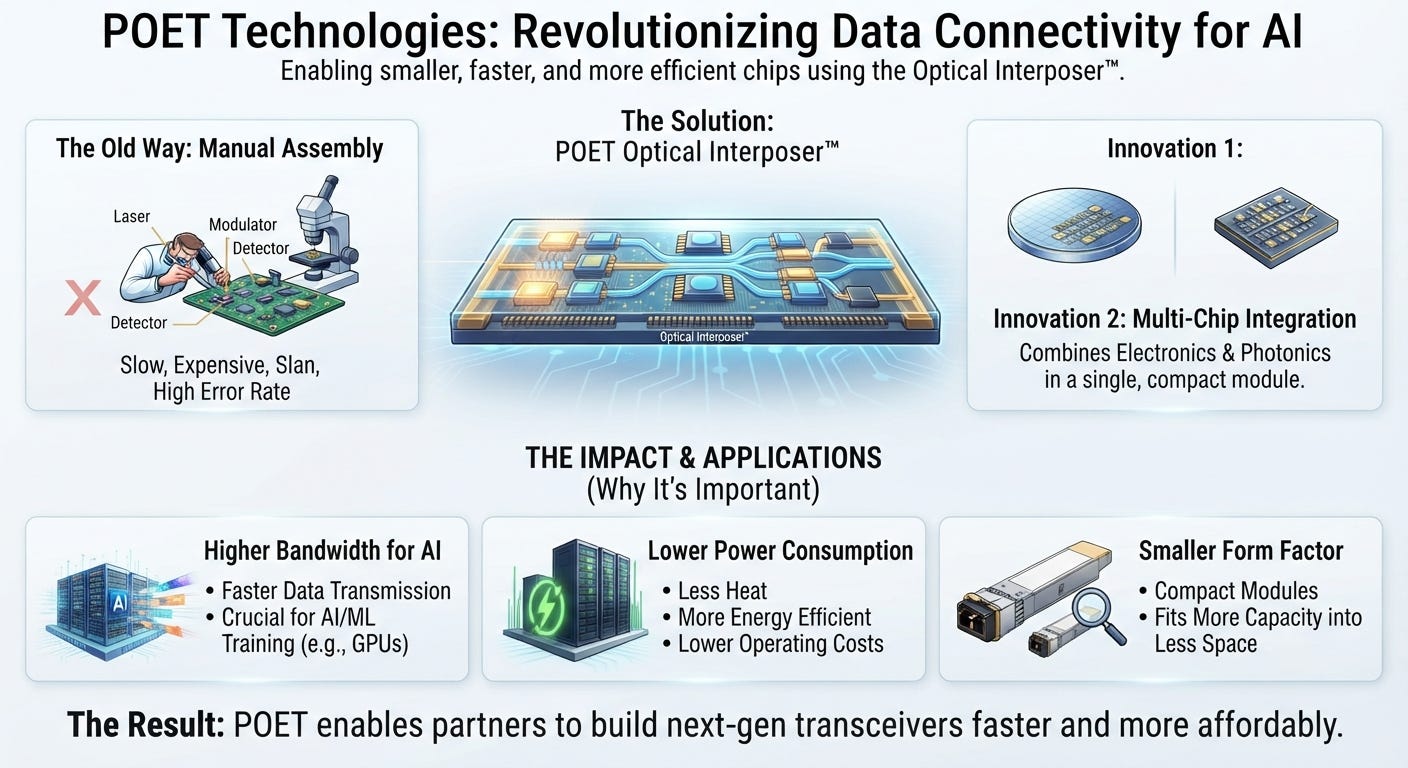
In traditional photonics, components are hand-assembled like a watch. POET’s interposer functions like a high-performance motherboard for light. It is a proprietary, patented wafer-level platform that allows electronic chips (drivers/controllers) and photonic components (lasers/modulators/photodetectors) to be integrated into a single, compact module using standard, high-volume semiconductor manufacturing processes. It effectively “siliconizes” light, moving photonics out of the artisan lab and into the mass-production foundry.
Value Proposition: The AI Bottleneck Solution
The AI industry is currently hitting a compute wall. GPUs are powerful, but they are starving for data. Moving that data via copper wires is slow, generates massive heat, and consumes exorbitant power. POET’s value proposition is a direct solution to the two biggest constraints in modern AI infrastructure: power and bandwidth density.
Passive Alignment (The Cost Killer):
The Problem: Legacy photonics rely on active alignment, where robots or humans must manually nudge lasers and waveguides into place while the system is on, checking for a signal. It is slow, prone to error, and agonizingly expensive at scale.
The POET Difference: POET’s platform uses passive alignment. Because the interposer is built with such high precision on a wafer scale, components can be dropped into place and locked down automatically, much like Lego bricks snapping together.
The Financial Impact: This eliminates the most expensive, time-consuming step in the entire manufacturing process. By moving from artisanal assembly to wafer-scale production, POET can reduce assembly costs by orders of magnitude compared to incumbent solutions.
Integration & Power Efficiency:
The Problem: As AI clusters scale, the energy required just to move data between GPUs accounts for a massive chunk of a data center’s power budget.
The POET Difference: By integrating the light source and the optical engine directly onto a single, tiny chiplet, and eventually moving toward Co-Packaged Optics, or CPO, POET drastically shortens the distance that data and electricity must travel.
The Performance Impact: This short-path architecture significantly reduces heat generation, lowers latency, and minimizes the power-per-bit required for transmission. In a data center containing millions of these links, these savings translate to lower OpEx for hyperscalers and a smaller thermal footprint, allowing them to pack more compute density into every rack.
Higher Bandwidth: POET’s architecture is inherently designed for the next generation of data speeds (800G, 1.6T, and beyond). Because their engine is integrated, they can achieve a bandwidth density that fast-and-narrow electrical approaches simply cannot match.
Business Model: Fabless/Hybrid
POET is neither a capital-intensive foundry owner nor a low-margin module assembler. They are a fabless intellectual property and architecture house.
The Model: They design the optical engines and license or supply the POET Optical Interposer platform to partners.
The Hybrid Strategy: By leveraging existing, massive CMOS-compatible foundries to manufacture their designs, POET avoids the multi-billion-dollar cost of building their own factories. This allows them to scale production up to the hyperscaler level (millions of units) without the balance-sheet-crushing CAPEX that would typically prevent a firm of their size from competing with industry giants.
Gannon Capital Neurodivergent Thoughts: The market for AI infrastructure is currently prioritizing speed and scale above all else. By positioning themselves as the “Intel Inside” of the optical engine, POET doesn’t need to dominate the entire market; they simply need to become the standard integration layer that manufacturers use to build their 800G and 1.6T transceivers. If they succeed, they capture the highest-margin slice of the value chain without the risk and costs associated with owning the brick-and-mortar factories.
The Thesis
The Data Center Bottleneck: Why Copper Is Dying
For years, the AI data center build-out was a race for compute, more GPUs, more HBM (High Bandwidth Memory), more raw power. But in 2026, the bottleneck has shifted. The industry has reached a physical wall where copper-based interconnects can no longer move data between these powerful chips fast enough, nor efficiently enough, to prevent the GPU clusters from idling.
The Physics Wall: As speeds push toward 800G and 1.6T, electrical signals traveling through copper circuit boards degrade rapidly. To compensate, designers have to add power-hungry retimers and equalizers just to keep the signal clean.
The Power Tax: In modern AI clusters, the energy cost of simply moving data across the rack is becoming a dominant portion of the total power budget. For a massive hyperscaler, this is an operational crisis that limits how many GPUs can actually be packed into a single data center.
The Macro Tailwind: The Era of Co-Packaged Optics (CPO)
The industry’s answer is Co-Packaged Optics (CPO), the process of moving the optical engine off the front panel of the switch and directly onto the board, right next to the processor (the XPU/GPU).
By collapsing the distance data must travel from inches to millimeters, CPO fundamentally alters the energy economics of AI:
Power Efficiency: Moving from traditional pluggable optics to CPO can reduce link power consumption by over 60% (e.g., dropping from 30W to 9W per link). This is the “Holy Grail” for data center operators trying to cram more compute density into limited power envelopes.
Bandwidth Density: With the optical engine closer to the compute die, data can move in and out of the GPU at unprecedented speeds, effectively unlocking the full potential of next-gen AI hardware.
The “Intel Inside” Approach: The Platform Play
This is where POET’s thesis becomes an asymmetric opportunity. Most photonics companies are trying to sell a finished transceiver. They are competing in a low-margin, high-commodity market.
POET has chosen a different, far more valuable path: The Platform Strategy.
By focusing on the POET Optical Interposer™, they aren’t trying to build the whole product; they are building the infrastructure layer that the entire industry needs to build CPO-ready engines.
The Scalability Advantage: Because their interposer is agnostic and can be used to integrate lasers, modulators, and photodetectors from various suppliers onto one standard silicon wafer, it effectively becomes the “Intel Inside” of the photonics world.
Capital Efficiency: By remaining fabless and licensing this architecture, POET avoids the multi-billion-dollar trap of building their own manufacturing facilities. They are effectively positioning themselves as the “gatekeeper” of the CPO manufacturing process.
Gannon Capital Neurodivergent Thoughts:
If you believe the AI data center build-out is a multi-year supercycle, then you have to believe that optics must eventually integrate directly into the package. POET’s master plan is to sell the manufacturing method that makes that integration possible. If they win the platform race, they become a structural necessity for every hyperscaler building a 1.6T+ AI cluster.
The Competition
The market for AI optical infrastructure has recently become a strategic theater for the world’s most powerful tech companies. POET sits in a unique, albeit crowded, position.
Incumbent Optical Giants (The Old Guard)
The Players: Coherent (COHR 0.00%↑ ), Lumentum (LITE 0.00%↑), and Ciena (CIEN 0.00%↑).
The Moat: These companies possess the traditional industrial advantages: multi-billion-dollar balance sheets, decades of relationships with major hyperscalers, and vertically integrated supply chains.
The Vulnerability: Their strength is also their anchor. These firms have spent decades optimizing for pluggable transceivers. As the industry shifts toward Co-Packaged Optics (CPO) and board-level integration, these incumbents face the innovator’s dilemma. They are heavily invested in the old way of building optics (the expensive, hand-assembled pluggables). Shifting their entire manufacturing backbone to match POET’s wafer-level, passive-alignment model is an existential challenge that risks cannibalizing their current high-margin product lines.
Silicon Photonics Innovators (The Disruptors)
The Players: A mix of venture-backed startups (like Ayar Labs) and established semi-cap players (like Intel’s silicon photonics division).
The Approach: These competitors are all racing to solve the same problem: “How do we get light onto the compute die?” Some are betting on monolithic integration (building the laser into the silicon itself), while others are using proprietary interposers.
POET’s Edge: While many of these startups are trying to build the whole widget (the laser, the driver, the modulator, the packaging), POET’s Optical Interposer™ strategy is intentionally agnostic. By focusing on the platform that brings these components together, POET doesn’t have to win every single component battle. If their interposer becomes the industry-standard motherboard for optical engines, they win regardless of which specific laser or modulator manufacturer their partners choose.
Hyperscaler Vertical Integration (The Ultimate Arbiter)
The Threat: Companies like Nvidia, Google, and Microsoft are no longer just customers; they are becoming the architects. We’ve seen this with Nvidia’s $4B strategic investment into the photonics sector (specifically Coherent and Lumentum) and Credo’s acquisition of DustPhotonics to bring SiPho technology in-house.
The Risk: The greatest long-term risk isn’t that a competitor makes a better optical engine, it’s that the hyperscalers decide to bypass the vendor ecosystem entirely, bringing the design and manufacturing of these engines in-house to optimize for their own custom AI chips.
The POET Counter-Play: This is why POET’s fabless, platform-centric model is so vital. By not owning the physical fabs, POET is a capital-light partner. Hyperscalers generally prefer to avoid the massive CAPEX of owning and operating optical fabrication plants if they can license a standard, scalable design from a company like POET. POET is betting that the hyperscalers would rather have a standardized, foundry-backed engine ecosystem (which POET enables) than build their own bespoke, proprietary manufacturing nightmares from scratch.
Gannon Capital Neurodivergent Thoughts:
In this race, the incumbents are fighting to protect their existing margins, and the hyperscalers are fighting to own the entire supply chain. POET is threading the needle: they are providing the standardized manufacturing platform that both the incumbents and the hyperscalers need to scale production without the crushing cost of vertical integration. The multi-billion dollar question here is “Will POET’s tech be so good that it leaves the competition with no choice but to integrate their technology; and if they do decide to partner with them, will POET be able to meet the extraordinary demand that will follow?”
The Moat
If the thesis is the promise, then the moat is the proof. POET’s competitive advantage rests on a triple-layered defense that moves beyond simple intellectual property into the realm of manufacturing and architectural dependency.
1. The IP Stack: A Platform, Not Just a Product
Most photonics companies rely on a “hero component,” a single, clever laser or modulator design that is easily copied or bypassed by newer technology. POET’s IP stack is fundamentally different; it is a manufacturing platform.
The Patent Defensive: Their patents cover the Optical Interposer™, which acts as the universal substrate for photonic integration. This protects the entire method of integrating disparate electronic and photonic components at the wafer scale.
Why it matters: By patenting the method of integration rather than just the final widget, POET creates a toll booth around the manufacturing process itself.
If a competitor wants to solve the heat and bandwidth issues of AI hardware using wafer-level integration, they inevitably run into POET’s IP blockades.
2. Structural Cost Advantage: The “Fabless” Arbitrage
This is the most misunderstood part of POET’s moat. Many investors assume that owning the factory is a sign of strength (like Intel or TSMC). In the hyper-competitive world of optical modules, it is actually a liability.
The Incumbent Anchor: Giants like Coherent and Lumentum have billions of dollars tied up in legacy photonics facilities that rely on labor-intensive, active-alignment processes. They cannot walk away from those assets overnight.
The POET Edge: POET is fabless by design. They don’t own the factories; they own the processes that run inside them. By partnering with world-class foundries (such as their ecosystem in Malaysia with Globetronics and NationGate), they gain the ability to scale to 1 million+ units per month without the multi-billion-dollar CAPEX that would bankrupt a smaller player.
The “Ford” Moment: Just as Henry Ford didn’t just build a car, but a process to build cars, POET is effectively bringing the assembly line to photonics. This structural shift allows them to drive down costs in a way that incumbent, vertically integrated players cannot match without dismantling their own existing business models.
3. Architectural Lock-in: The “Design-In” Moat
In the semiconductor industry, the strongest moat isn’t a patent; it’s being designed into the next generation of hardware.
The Switching Cost: When a hyperscaler or module manufacturer selects the POET Optical Interposer, they are aligning their entire hardware architecture around it. They are validating the thermal profiles, the power footprints, and the signal integrity of the POET platform.
The Sticky Reality: Once an AI hardware engineer integrates POET’s engine into their server designs, ripping it out to try a competitor’s solution carries massive risk and engineering overhead. This creates a sticky relationship that acts as a long-term barrier to entry for any competitor trying to offer a cheaper version of the same thing.
Gannon Capital Neurodivergent Thoughts:
POET’s moat is not just defensive; it is economic. By decoupling themselves from the cost of fabrication (the fabless model) while entrenching themselves into the architecture of their customers (the design-in process), they have built a business model that is as much a financial moat as a technical one. They are effectively offloading the risk of manufacturing to partners while retaining the high-margin, scalable core of the IP. If they can “get in” they’ll almost certainly remain there for the foreseeable future.
Strategic Partnerships & Alliances
For a company like POET, partnerships are the mechanism of their survival and scaling. Their strategy is to outsource the heavy lifting (manufacturing) and focus on the intellectual high ground, the Optical Interposer™.
1. Foundry Partners: The Fabless Scalability
POET’s most critical decision was adopting a fabless manufacturing model. By partnering with established outsourced semiconductor assembly and test (OSAT) providers and foundries, most notably in Southeast Asia, POET avoids the capital trap that destroys many hardware startups.
The Advantage: Rather than spending billions to build their own cleanrooms, POET uses existing, mature CMOS-compatible infrastructure. This allows them to scale their output to the hyperscaler level, millions of units, without the balance-sheet-crushing CAPEX that would otherwise be required.
Current Focus: They are currently in the midst of a massive production ramp, aimed at increasing capacity to a target of 1 million units per month by the end of 2027.
2. Commercial Engagements: The Lumilens Anchor
The landmark agreement with Lumilens two months ago was the cornerstone of POET’s commercial validation.
The Deal: It includes an initial $50 million purchase order for Electrical-Optical Interposer (EOI)-based engines, with a roadmap that could scale to $500+ million in cumulative purchases over five years.
Why it matters: This is a proof-of-concept for scalability. It validates that the industry is ready to transition to the POET Optical Interposer™ for next generation 800G and 1.6T networking. The deal also includes warrants that align Lumilens’ financial success with POET’s long-term stock performance, creating a strong incentive for the partnership to succeed.
3. AI Ecosystem: External Light Sources (ELS)
As AI data centers move toward Co-Packaged Optics (CPO), the light source (the laser) is being moved outside the compute package to save power and reduce heat.
The Sivers Collaboration: POET has entered a strategic collaboration with Sivers Semiconductors to develop External Light Source (ELS) modules. This partnership combines Sivers’ high-power DFB laser technology with POET’s Optical Interposer platform.
Market Impact: By developing standardized ELS modules, POET is positioning itself to be a plug-and-play supplier for the next generation of AI-driven GPU clusters. Prototypes are currently in the demonstration phase, with production readiness targeted for late 2026.
Recent Developments & Commercial Context
As an investor, you must also maintain a clear-eyed view of the risks inherent in these partnerships.
The Execution Watch: Management has reiterated that the production ramp remains on schedule for volume shipments in the second half of 2026. The sampling window for their next-gen engines (late 2026) is the single most important milestone for the remainder of the year. Investors are closely watching this period to see if the company can convert these partnerships into consistent, high-margin revenue.
Transparency & Risk: The company’s recent history is a reminder of the volatility that comes with a stock being in its execution phase. In April 2026, the company faced a public controversy regarding the cancellation of purchase orders from Celestial AI due to a breach of confidentiality. This event caused significant short-term volatility, highlighting the reality that in the world of high-stakes AI supply chains, commercial relationships are delicate and public-market expectations are unforgiving.
Gannon Capital Neurodivergent Thoughts:
POET is currently in a “show-me” period. The Lumilens deal and the Sivers collaboration provide the foundational demand, but the market is now waiting for the proof of delivery. The partnerships are in place and now the company must prove it can manage the manufacturing complexities, avoid further commercial hiccups, and hit the volume production targets scheduled for late 2026 and beyond. The next couple of years are the test, and once the back half of 2028 comes around, POET has to have all their ducks in a row to prove they can be a reliable source for the future generation of data centers.
The Numbers
Revenue Profile: The Early Commercial Transition
As of the Q1 2026 earnings report (released May 14, 2026), POET is no longer pre-revenue and is now in the early innings of commercialization.
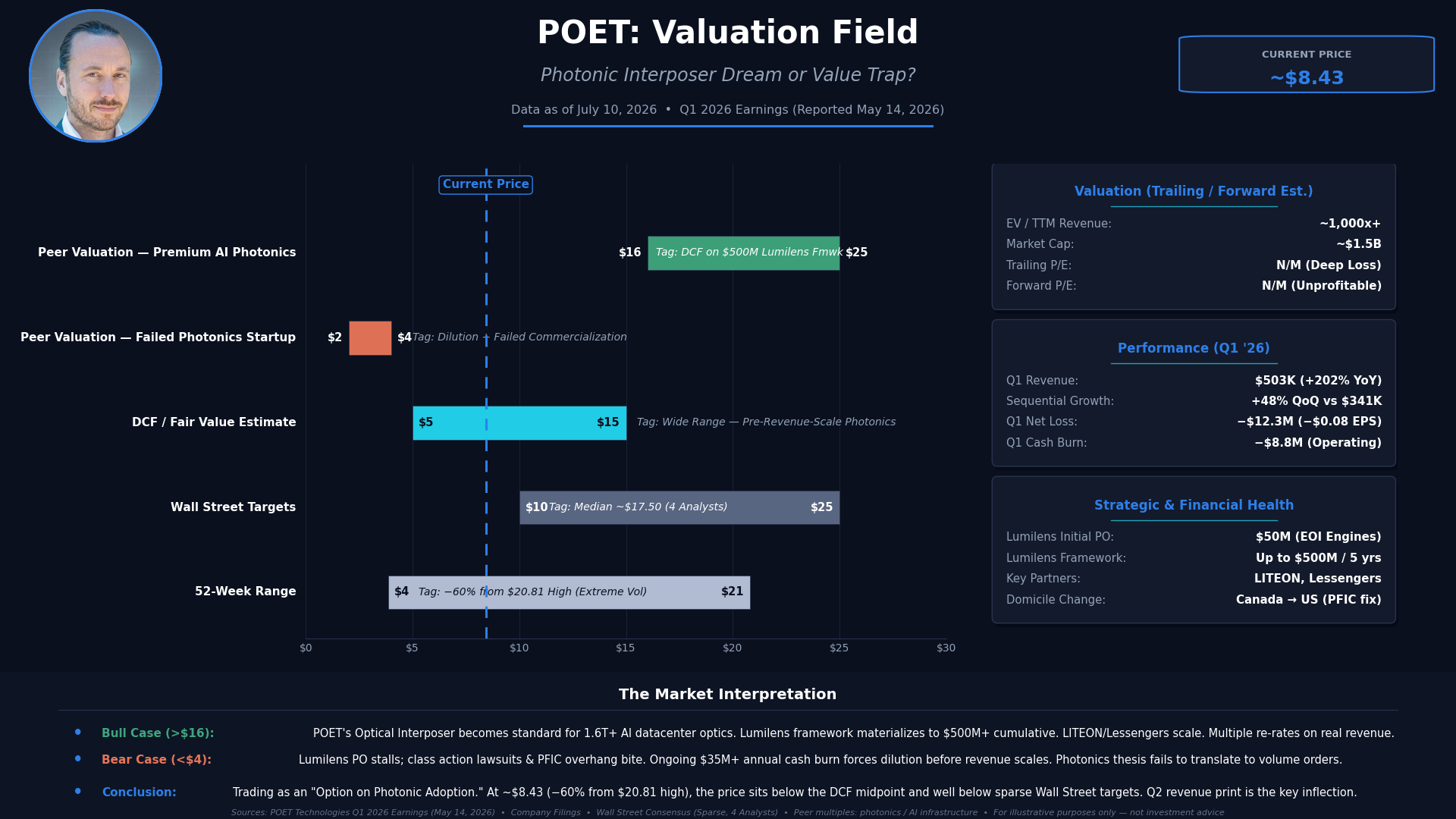
The Baseline: Revenue for Q1 2026 was $503,389, a significant jump from $166,760 in the same quarter a year prior.
The Nuance: This revenue is primarily driven by NRE (Non-Recurring Engineering) fees and early-stage product shipments rather than mass-volume commercial sales. For an investor, the revenue figure itself matters less than the velocity of growth and the type of revenue. You are looking for a transition from one-off engineering fees (NRE) to recurring, high-volume production orders, a shift that is currently the primary KPI for management.
Capital Position: The $400M War Chest
The financial narrative changed in May 2026 when the company closed a US$400 million registered direct offering.
The Runway: As of March 31, 2026, the company held approximately $429 million in cash and short-term investments. This liquidity is the “life insurance” of the investment thesis. It effectively de-risks the company’s ability to fund its manufacturing build-out in Malaysia and its R&D programs for the next several years.
The Dilution Trade-off: While this capital injection prevents a liquidity crisis, it came at the cost of significant shareholder dilution. Investors must weigh the long-term benefit of a well-funded balance sheet against the short-term reality of a larger share count. The $400M raise was the cost of securing the company’s future, but it sets a high bar for future earnings-per-share (EPS) growth.
Profitability: The Investment Phase Reality
POET is currently operating in a classic “burn-to-scale” mode.
The Bottom Line: The company reported a net loss of $12.3 million for Q1 2026.
Where the Money Goes: Expenses are heavily weighted toward R&D and scaling infrastructure. The company is aggressively investing in:
Malaysia Manufacturing: Building out the back-end assembly and testing capacity.
Headcount & Engineering: Hiring the talent required to support 800G and 1.6T transceiver development.
The Forward Guidance: While the company did not provide specific revenue guidance for the remainder of 2026, management has pointed to specific operational milestones: production ramp-up, the completion of the Malaysian manufacturing build-out, and the delivery of 800G and 1.6T prototypes.
Gannon Capital Neurodivergent Thoughts:
The Q1 2026 net loss is an operational cost of entry. In this sector, profitability is a lagging indicator. The leading indicators are the revenue growth (which tripled YoY) and the cash balance, which is now robust. If you see the NRE revenue continue to climb in Q2 and Q3, it suggests that the design-win pipeline is converting. If the cash burn accelerates without a corresponding ramp in production, that is the primary risk factor to watch.
The narrative gets us to the door, but the math is what tells us if it is worth opening.
We’ve established the technological moat and the market positioning. In the premium section below, I’ve built out a three-scenario valuation model with my Base, Bull, and Bear cases to help us stress-test the current price against the probability of future execution. We’ll also dissect the specific risk factors that could derail the thesis, and I’ll share my final, actionable thoughts on exactly how I’m sizing and positioning this trade.
To read the full financial breakdown, access the valuation scenarios, and see if and when I’m factoring this into the Gannon Capital portfolio, upgrade to a paid subscription below.
