Ouster Deep Dive
Digital Silicon, Real-World AI: Inside Ouster’s Battle to Map the Physical World

To truly understand Ouster (OUST 0.00%↑), you have to appreciate the specific psychological architecture required to build it.
Lidar engineering demands intense, uninterrupted technical sprints, acute systematic pattern recognition, and an almost fanatical hyper-focus. It is a grueling, multi-dimensional chess match played at the intersection of quantum physics, custom silicon design, and advanced photonics. It is an environment where neurodivergent talent, individuals with autism or ADHD who can intuitively manipulate complex, multi-layered data matrices in their minds, are the foundational engine of innovation.
Yet, this reality introduces a profound, unvarnished paradox. The very neurodivergent traits that give Ouster its technological edge also clash violently with rigid startup organizational structures, aggressive public-market timelines, and top-down corporate hierarchies. When communication styles fail or engineering sprints are forced into inflexible corporate molds, critical points of friction emerge. This human capital dynamic, the hidden key-man risk of losing hyper-specialized silicon architects, is the invisible variable that will determine whether Ouster successfully scales or stalls out.
Ouster has recently exploded in popularity, transitioning from a niche automotive sensor provider into a highly debated “Physical AI” powerhouse. The hype is being driven by a massive structural pivot. In May 2026, Ouster unveiled its REV8 OS sensor family, powered by the proprietary L4 Silicon chip. It represents a paradigm shift: the world’s first native-color lidar system, fusing 3D structural data and 48-bit color depth directly on a single piece of semiconductor physics, bypassing the lag and clutter of traditional software sensor fusion. Coupled with a staggering 49% year-over-year revenue surge to $48.6 million in Q1 2026 and a defensive moat bolstered by sweeping federal trade restrictions against Chinese rivals, Ouster is positioning itself as the literal “eyes” of autonomous machines.
But the financial machinery under the hood is moving just as fast, and not without friction. Just weeks ago, on July 6, 2026, management executed a massive, dilutive $200 million public stock offering, catching early investors off guard and sending the stock tumbling 16% in a clear reminder of the company’s aggressive cash-burn realities.
To evaluate Ouster as a long-term investment, we must look past the superficial bull case. We have to look at the chips, the numbers, the human capital, and the macro forces.
Origin Story
In the early days of autonomous vehicle development, lidar was the most glaring, expensive bottleneck on the road. The industry was dominated by analog lidar systems, which were exotic, hand-assembled mechanical monoliths. These legacy sensors relied on hundreds of discrete, painstakingly aligned lasers, receivers, and mirrors spinning in a delicate mechanical dance.
They were fragile, highly prone to physical failure under heavy industrial vibration, and cost upwards of $75,000 per unit. They were essentially custom aerospace instruments forced to do the dirty, high-vibration work of earthmoving, shipping, and automated warehouse logistics.
In 2015, Ouster’s founders, Angus Pacala and Mark Frichtl, realized that if lidar was ever going to scale, it had to stop being a mechanical assembly and start being a semiconductor.
They threw out the spinning gears and the thousands of discrete parts, replacing them with a highly elegant, patented two-chip digital architecture.
1. Chip One: The VCSEL Laser Array
Instead of using expensive, bulky edge-emitting lasers, Ouster utilizes a Vertical-Cavity Surface-Emitting Laser (VCSEL) array. This technology is structurally identical to the low-cost, highly reliable micro-lasers that power Apple’s FaceID on millions of iPhones.
Ouster’s breakthrough was packing up to 128 (and now, 256 in the L4 Silicon generation) of these micro-emitters onto a single piece of silicon no larger than a grain of rice.
The Advantage: Massively reduced footprint, low power consumption, and a cost curve that does not scale linearly with resolution. Adding more lasers simply requires a denser etch on the silicon wafer, not adding more physical parts.
2. Chip Two: The CMOS Receiver SoC
To catch the reflected laser pulses, Ouster designed a custom Complementary Metal-Oxide-Semiconductor (CMOS) System-on-a-Chip (SoC).
This chip is packed with Single-Photon Avalanche Diode (SPAD) detectors. SPADs are incredibly sensitive, quantum-level photon counters capable of timestamping individual, returning packets of light with picosecond (one-trillionth of a second) precision.
Because the receiver is built on standard silicon CMOS, Ouster can integrate massive digital signal processing (DSP) logic directly on the exact same die. The incoming analog light is immediately converted into clean digital 1s and 0s right at the detector level.
The Silicon Leverage
By consolidating a room’s worth of optical complexity down to just two chips and a simple micro-optic lens system, Ouster unlocked a fundamental economic cheat code: Moore’s Law.
While legacy analog competitors are structurally limited by the physical costs of glass, copper, and mechanical labor, Ouster’s performance doubles and its manufacturing cost drops every time the global semiconductor industry advances a node.
This digital transition is the bedrock of Ouster’s entire thesis. It is why they can aggressively target industrial and municipal markets where a $10,000 analog sensor is dead on arrival, but a ruggedized, sub-$1,000 digital sensor is highly disruptive.
History
Ouster’s trajectory is defined by a highly aggressive M&A strategy. Recognizing that a fragmented hardware market would lead to margin erosion and customer confusion, management executed two massive consolidation waves. The first systematically absorbed their primary legacy competitor to gain scale; the second integrated multi-modal sensing to own the entire Physical AI perception stack.
The Consolidation Wave: Absorbing Velodyne (2023)
In February 2023, Ouster completed an all-stock merger of equals with its primary legacy rival, Velodyne. On paper, it was presented as a strategic combination. In operational reality, it was a systematic, hostile architecture migration masquerading as a merger.
The IP Roll-Up: Velodyne was a pioneer of analog mechanical lidar, holding an expansive portfolio of foundational patents. By acquiring Velodyne, Ouster instantly gained control of over 600 combined patents and applications, effectively neutralizing ongoing, highly expensive patent litigation and building an impenetrable IP moat.
The Forced Customer Migration: Velodyne’s legacy customer base was built on its famous, analog “Puck” sensors. However, these mechanical sensors were expensive to manufacture and carried poor long-term margins. Post-merger, Ouster systematically began sunsetting Velodyne’s complex mechanical hardware, forcing a massive, sticky customer base (over 850 combined clients at the time) onto Ouster’s high-margin, digital CMOS architecture.
Operational Squeezing: Within nine months of closing, Ouster aggressively cut overlapping corporate functions, realigned manufacturing footprints, and extracted over $75 million in annualized operating expense synergies.
The Perception Acquisition Spree: Building the Physical AI Brain
Ouster realized early on that selling raw 3D hardware limits a company to low-margin commoditization. To insulate the business, they went on a strategic acquisition spree to build a fully integrated spatial intelligence platform, owning the hardware, the software, and the sensor-fusion compute layer.
Phase 1: Sense Photonics - The Solid-State Foundation (2021)
Ouster acquired Sense Photonics in an all-stock transaction to accelerate its Digital Flash solid-state lidar roadmap.
Unlike spinning sensors, solid-state lidar has zero moving parts, making it highly desirable for automotive ADAS (Advanced Driver Assistance Systems) due to its seamless, low-profile integration behind windshields or grilles.
Phase 2: Stereolabs - Fusing Vision, Depth, and AI (February 2026)
In February 2026, Ouster closed the critical acquisition of Stereolabs for $35 million in cash and 1.8 million shares.
Stereolabs brought over 10,000 global customers, a highly successful line of industrial-grade stereoscopic 3D cameras (ZED series), and a highly optimized Neural Depth Engine.
The Sensory Pivot: This acquisition transformed Ouster from a lidar hardware manufacturer into a comprehensive Physical AI leader. By pairing Ouster’s long-range digital lidar with Stereolabs’ high-density RGB camera data, the company created an out-of-the-box, calibrated sensor-fusion engine.
By owning both the eyes (lidar + cameras) and the brain (perception software + neural depth engines), Ouster can offer customers a unified platform powered by edge-AI compute (utilizing NVIDIA Jetson Orin modules).
In April 2026, this culminated in the release of the ZED X Nano, a ruggedized, wrist-mounted stereo camera built explicitly for robotic arms, imitation learning, and high-throughput Physical AI training data. This software-hardware integration is where Ouster’s ultimate value proposition lies, and where they plan to escape the hardware margin trap.
The Business: What They Do
Ouster is often miscategorized as a basic hardware component vendor, a company that simply sells high-tech laser boxes. But in the context of the global artificial intelligence infrastructure buildout, Ouster operates at a much more strategic vantage point.
When you map the macro-AI investment landscape across its 12 structural layers, Ouster doesn’t just sit passively in a single vertical; it acts as a critical hardware-software bridge between two major pillars: Layer 5 (Compute Hardware) via its custom silicon designs and the specialized Layer 11 (Edge and Physical AI) deployment paradigm that runs parallel to the lower layers of the stack.
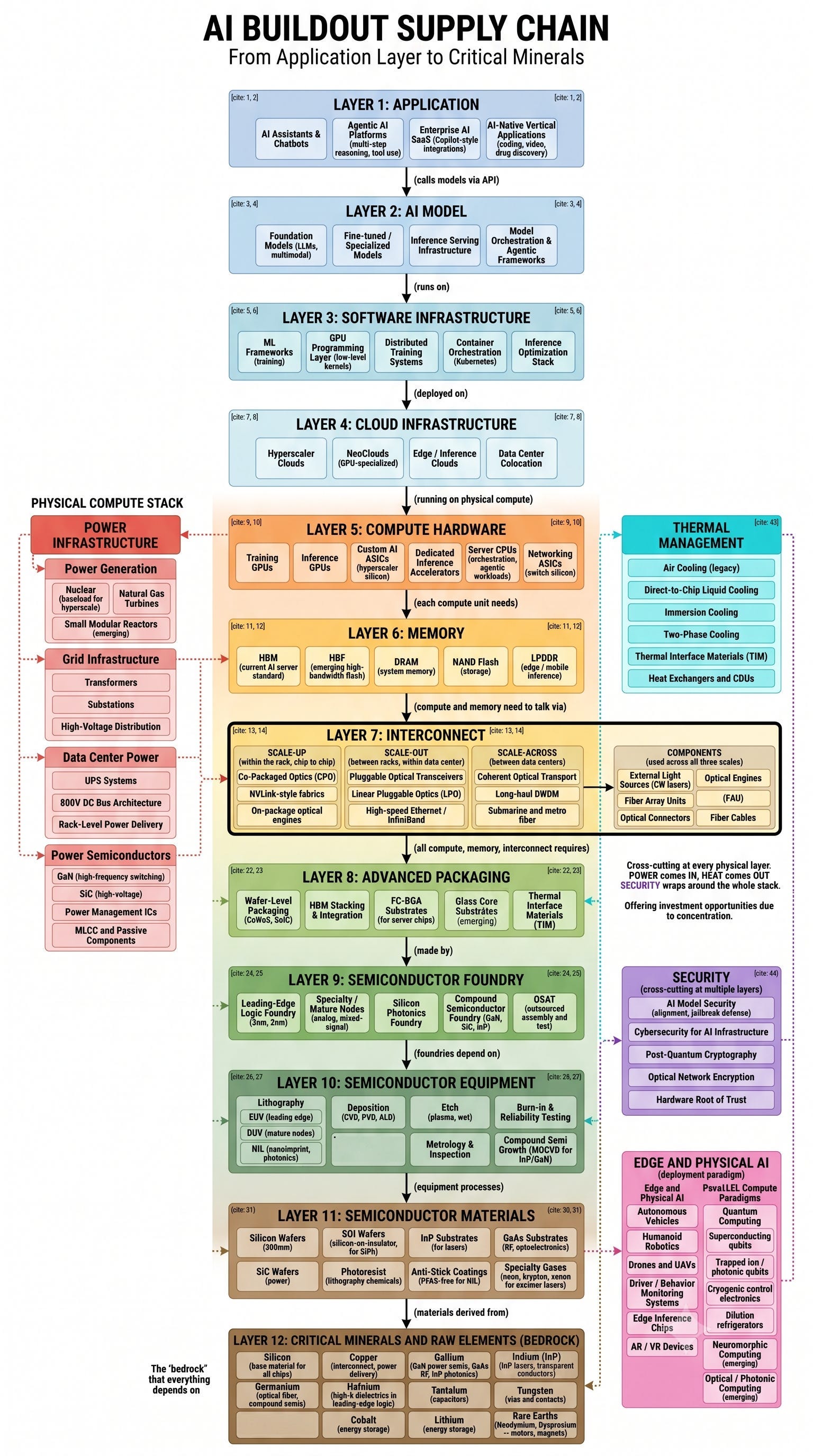
Where Ouster Sits: The Layer 5 to Layer 11 Bridge
Large Language Models (LLMs) live in data centers, consuming text and pixels to generate abstract answers. But as the frontier of AI shifts toward Physical AI, these models must inhabit machines, autonomous forklifts, port cranes, mapping drones, and security robots. They move through the chaotic, unpredictable physical world.
The Hardware Foundation (Layer 5: Compute Hardware): Because of its patented two-chip architecture, Ouster functions fundamentally as a fabless semiconductor designer. Instead of building complex mechanical assemblies, it designs Custom AI ASICs (hyperscaler silicon / specialized inference). Its sensors are essentially highly specialized, spatial-compute processors that rely on standard global foundry scaling to double performance and cut costs with every chip generation.
The Deployment Paradigm (Edge and Physical AI): This is where Ouster’s ultimate business intent lies. To operate safely, an autonomous vehicle, drone, or humanoid robot cannot rely purely on loose software interpretations of video frames. It requires deterministic, physical spatial clarity. Ouster provides the native perception layer that translates reality into mathematical coordinates (point clouds) that an Edge and Physical AI brain can instantly parse without burning massive downstream compute overhead.
The Core Hardware Lineup: Capturing the Data
Ouster captures these physical environments via its three primary digital lidar product lines. Every single sensor is built to survive environments that would instantly destroy standard optical cameras:
OS0 (Ultra-Wide View): Built for close-range navigation, indoor logistics, and robotaxis. It provides a 90-degree vertical field of view, acting as the peripheral vision for autonomous platforms.
OS1 (The Flagship Mid-Range): The workhorse of the fleet. Widely used in industrial automation, mining, and agriculture. It balances range (up to 200 meters) with high resolution.
OS2 (Long-Range Sentinel): Designed for high-speed tracking, highway-speed autonomous trucking, and long-range security mapping. It scans up to 400 meters out, capturing high-velocity objects long before they enter a vehicle’s path.
The REV8 & L4 Silicon Evolution (The Real AI Catalyst)
Unveiled just two months ago in May 2026, the REV8 OS sensor family is powered by the custom L4 Silicon chip. This is the specific development that has driven Ouster’s recent popularity among deep tech investors.
Prior to the L4 chip, a robot needed a lidar sensor for depth and a separate RGB camera for color. Engineers had to run complex, compute-heavy calibration software to “glue” the 2D camera image onto the 3D lidar map, a process prone to lag, lens distortion, and error.
The L4 Breakthrough: The L4 Silicon chip processes up to 20 trillion photons per second. It introduces native-color digital lidar. By embedding ambient light detection natively onto the SPAD receiver array, the REV8 sensor outputs a completely unified data stream: a 3D structural point cloud with 48-bit color depth baked directly into every single pixel at the hardware layer.
Moving Up the Stack: Gemini & BlueCity (SaaS Layer)
Hardware commoditizes over time, which is why Ouster is aggressively building an enterprise software layer directly on top of its sensors:
Ouster Gemini: An enterprise spatial-intelligence platform that tracks people and vehicles across wide environments. It aggregates data from multiple sensors, serving as an operating system for automated security, crowd management, and factory safety.
BlueCity: A turnkey solution focused entirely on Intelligent Transportation Systems (ITS). It monitors intersections, optimizes traffic-light timing based on real-time pedestrian presence, and predicts near-miss collisions to improve municipal safety.
By selling hardware bundles wrapped in multi-year Gemini or BlueCity software contracts, Ouster is attempting to escape the boom-and-bust cycles of pure hardware components, carving out a sticky, recurring revenue stream in the broader AI infrastructure buildout.
Gannon Capital Neurodivergent Thoughts
Traditional sensor fusion, stitching a 2D color camera feed onto a separate 3D lidar map, is the computational equivalent of sensory overload. The machine’s “brain” is forced to constantly reconcile two completely different versions of reality, burning massive compute overhead just to correct for time lags and spatial distortion.
The L4 chip eliminates this executive dysfunction at the hardware layer. By capturing depth and 48-bit color simultaneously on a single array, the data is born fully integrated. For a Physical AI, receiving a native-color point cloud removes the chaotic noise of software translation, trading intense sensory clutter for absolute, deterministic clarity.
The Thesis: The Inflection Point of Physical AI
The central paradox of the autonomous vehicle revolution is that it left a trail of bankrupt lidar companies in its wake. High-profile names bled hundreds of millions of dollars in capital while waiting for multi-year passenger automotive OEM design wins that were perpetually delayed or cancelled.
Ouster survived, and is now approaching a structural inflection point, because it rejected that single-threaded automotive narrative. Instead, management built an operational thesis centered around immediate cash generation in rugged industries and a full-stack ecosystem capture of Edge and Physical AI.
1. The Non-Automotive Cash Engine
While competitors tied their fates to luxury consumer cars, Ouster targeted Industrial Automation and Smart Infrastructure. These verticals possess radically different business economics that have enabled Ouster to outpace the industry:
Compressed Sales Cycles: Securing a design win with a global automotive manufacturer takes 5 to 7 years of un-monetized R&D. Conversely, retrofitting a fleet of autonomous forklifts for a logistics giant or deploying automated terminal tractors at a major shipping port takes months.
Superior Pricing Power & Margins: Automotive OEMs squeeze component suppliers down to razor-thin margins. Industrial, mining, and agricultural buyers, however, prioritize equipment uptime and extreme ruggedness (such as Ouster’s shock-tested IP68/69K ratings). They willingly pay a premium for hardware that prevents catastrophic operational downtime.
Immediate “Scale In” Infrastructure: In 2026, the Intelligent Transportation Systems (ITS) industry transitioned from experimental pilots to city-wide rollouts. Ouster capitalizes on this via massive, formalized municipal deployments, such as its 130+ intersection grid in Chattanooga and over 100 intersections in Utah.
This diverse industrial cash engine allowed Ouster to achieve $48.6 million in Q1 2026 revenue (a 49% YoY surge), entirely insulating the business from the sluggish passenger EV market.
2. Physical AI Ecosystem Capture: Escaping the Hardware Trap
Selling raw silicon hardware is ultimately a race to the bottom. If Ouster only sold sensors, tech giants or subsidized foreign competitors could eventually commoditize their hardware margins. To block this, Ouster has spent years building a triple-threat ecosystem: The Hardware (REV8), The Compute, and Pre-Trained Perception Software (Gemini/BlueCity).
When an automation customer integrates Ouster, they are plugging into a complete spatial intelligence ecosystem:
The Zero-Copy Pipeline: By collaborating with cutting-edge physical AI foundational platforms like FieldAI (which designs universal robot “brains” for unstructured environments) and AIM Intelligent Machines (heavy earthmoving autonomy), Ouster embeds its REV8 L4 silicon directly into the core training models of modern robotics.
SaaS Lock-In: Once a city maps its entire traffic grid using Ouster’s BlueCity platform ahead of massive infrastructure events (like the New Jersey DOT deploying BlueCity across MetLife Stadium transit corridors for the mid-2026 FIFA World Cup final), the software layer becomes completely indispensable.
3. The 2026 Inflection Point: Why the Hype is Real Now
The broader AI narrative has officially moved past conversational chatbots. The market is aggressively funding the transition to Physical AI, the layer where autonomous vehicles, humanoid robotics, defense systems, and smart factory floors must compute reality in real time.
Ouster sits exactly at the bottleneck of this shift. Because its new REV8 family outputs a native 3D color point cloud directly from the chip, it slashes the massive computational power required by neural networks to fuse separate camera images and lidar frames. It makes the “brain” of a robot lighter, cheaper, faster, and exponentially more responsive. Ouster is approaching its true commercial inflection point because it has positioned its proprietary silicon to be the mandatory, universal entry point for all physical machine intelligence.
The Competition: The Geopolitical and Architectural Battleground
The lidar and physical AI sensor market is not a civilized corporate rivalry; it is a hyper-fragmented, highly litigious, and geopolitically charged warzone. While Ouster has successfully transitioned to a digital silicon architecture, its competitors are attacking from multiple angles: some lean on massive state-subsidized manufacturing scale, others hunt for exclusive multi-year automotive monopolies, and one massive outlier aims to eliminate the entire product category through software.
Below is the competitive matrix of the global landscape, mapping Ouster’s primary rivals and the specific, existential threats they pose to its business model.
1. The Geopolitical Cost Goliath: Hesai Group (HSAI 0.00%↑ )
Hesai is a manufacturing powerhouse based in Shanghai, dominating the global robotaxi and commercial lidar markets through raw volume. They specialize in high-performance sensors and have aggressively developed their own custom ASICs (such as the Picasso platform) to lower their bill of materials.
The Structural Weakness: Hesai is facing severe geopolitical headwinds in the West. It was placed on the U.S. Department of Defense’s list of Chinese military companies, effectively barring it from federal procurement and causing massive compliance anxiety among Western enterprise customers.
The Biggest Potential Threat to Ouster: The Non-Aligned Market Freeze. If Hesai is fully blocked from the U.S. and Europe, it will focus entirely on dominating China, Southeast Asia, Latin America, and the Middle East. With massive state-backed domestic volume, Hesai can depress global sensor pricing to a point where Ouster cannot compete in non-Western markets, permanently capping Ouster’s international scaling potential.
The Thailand Supply Chain Loophole: Hesai is actively constructing its massive “Galileo” automated manufacturing facility in Bangkok, Thailand. If Chinese players successfully use non-aligned Southeast Asian production hubs to bypass Western tariff structures and satisfy enterprise compliance anxieties, they can deploy their hyper-volume economies of scale, doubling capacity to 4 million units.
2. The Domestic Fast-Follower: RoboSense ($2498.HK)
Backed by Chinese automotive and tech giants like BYD and Alibaba, RoboSense has scaled phenomenally quickly by focusing on mass-market automotive integrations. They specialize in solid-state and MEMS (Micro-Electro-Mechanical Systems) lidar, providing low-profile sensors optimized for passenger vehicle assembly lines.
The Structural Weakness: Like Hesai, RoboSense faces tightening trade restrictions, tariffs, and intellectual property scrutiny in Western markets, leaving them highly exposed to the domestic Chinese automotive price war.
The Biggest Potential Threat to Ouster: IP Infringement and Hardware Commoditization. RoboSense excels at rapidly reverse-engineering and adapting Western technology concepts at a fraction of the R&D cost. If they successfully bypass Ouster’s digital lidar patents or produce a “good enough” low-cost digital clone for global industrial markets, they could trigger a race to the bottom, stripping Ouster of its premium hardware margins.
3. The Bespoke Automotive Titan: Luminar Technologies (LAZR 0.00%↑)
Luminar is the poster child for passenger vehicle lidar integration, securing high-profile development deals with premium automotive brands like Volvo and Mercedes-Benz. They operate at a different wavelength, literally, utilizing a 1550nm fiber laser architecture that allows for extreme long-range tracking and high resolution at highway speeds.
The Structural Weakness: Luminar’s 1550nm architecture relies on expensive, exotic materials like Indium Gallium Arsenide (InGaAs) rather than standard silicon. This has crippled their margins, leading to extreme cash burn and repeated delays in scaling mass assembly lines.
The Biggest Potential Threat to Ouster: The Tier-1 Automotive Lockout. If Luminar successfully resolves its manufacturing bottlenecks and proves that its ultra-long-range 1550nm sensor is the only safe option for high-speed autonomous highway driving, they could lock down the global passenger automotive market entirely. This would force Ouster to remain permanently sidelined in lower-speed industrial and municipal niches.
4. The Agile Dealmaker: Innoviz Technologies (INVZ 0.00%↑)
Innoviz is an Israeli lidar pioneer that secured massive, multi-billion-dollar forward-looking design wins with major OEMs like BMW and the Volkswagen Group. They specialize in high-performance solid-state lidar designed to meet the brutal safety and regulatory standards of the consumer automotive world.
The Structural Weakness: Their revenue is entirely tied to the whims of legacy car companies. When Volkswagen or BMW delay their software-defined vehicle architectures, Innoviz’s revenue pipeline stalls out, forcing them to survive on continuous capital raises.
The Biggest Potential Threat to Ouster: Vertical Piracy. If consumer automotive growth remains stagnant, Innoviz will be forced to aggressively pivot into Ouster’s home turf: industrial automation, heavy machinery, and defense. Because Innoviz has already spent years optimizing their sensors for brutal automotive safety standards, they could rapidly repackage their hardware to steal Ouster’s core industrial customers.
5. The Existential Software Radical: Tesla (TSLA 0.00%↑) & The Vision-Only Camp
Led by Elon Musk, Tesla is the ideological arch-nemesis of the entire lidar industry. Tesla’s Full Self-Driving (FSD) architecture relies completely on a “vision-only” approach, using cheap, passive optical cameras and deep neural networks to infer 3D spatial geometry purely from 2D pixel data.
The Structural Weakness: Cameras are inherently passive; they struggle in blinding glare, heavy fog, pitch-black environments, and chaotic edge cases where LIDAR’s active photon counting is mathematically superior.
The Biggest Potential Threat to Ouster: If Tesla’s vision-only FSD achieves regulatory approval and widespread commercial success without ever using a lidar sensor, it will fundamentally shatter the investment thesis for spatial hardware. Industrial forklift manufacturers, drone builders, and municipal planners might conclude that paying for expensive lidar silicon is an unnecessary hardware tax, migrating entirely to cheap camera feeds running advanced, vision-based Physical AI models.
Gannon Capital Neurodivergent Thoughts:
Ultimately, the true threat matrix for Ouster does not come from legacy automotive rivals, but from an intense convergence of geopolitical pricing and software innovation. In the near term, Chinese giants like Hesai pose an aggressive commercial bottleneck; if trade barriers isolate them from the West, they will likely dump low-cost silicon platforms into international markets, heavily capping Ouster’s global expansion. Structurally, however, the ultimate existential threat is the exponential advancement of the vision-only paradigm championed by Tesla. If vision-based Physical AI models become sophisticated enough to compute flawlessly using cheap, passive optical cameras alone, the economic necessity for premium, active-photon lidar sensors will completely evaporate. Investors must weigh whether Ouster can solidify its semiconductor advantage before global price wars or software-only breakthroughs rewrite the rules of spatial intelligence.
The Moat
Evaluating a company’s long-term viability requires examining its moat, not just identifying it, but analyzing its true structural depth. For Ouster, the moat is an intriguing mix of airtight legal barriers, clever asset-light structural engineering, and intense internal human capital dynamics.
The Patent Wall
Why it is a moat: Lidar technology is an architectural minefield. By pulling off the massive Velodyne merger asset assimilation, Ouster consolidated the foundational, pioneering IP of the entire lidar industry while simultaneously acquiring customers. Ouster controls over 400 active patents globally. This means if a competitor wants to utilize multi-channel optical sensing architectures or specific SPAD (Single-Photon Avalanche Diode) receiver setups, they have to navigate Ouster’s legal perimeter.
Exactly how deep it really is: Moderately Deep to Formidable. In January 2026, the Federal Circuit dismissed major appellate validity challenges brought by Chinese rival Hesai over Ouster’s core distance-sensing and multi-channel patents (like U.S. Patent No. 11,190,750 B2), leaving Ouster’s claims fully intact and legally unchallenged. Ouster has successfully leveraged these multi-year legal battles to force settlements and private cross-licensing negotiations. However, because it is a defensive moat, it primarily keeps competitors out of the U.S. domestic market; it cannot completely prevent an offshore competitor from engineering an alternative architecture for non-Western jurisdictions, which China is notorious for.
Manufacturing Delegation
Why it is a moat: Building a custom semiconductor fabrication or precision optical assembly plant costs hundreds of millions of dollars in capital expenditure (CapEx). By outsourcing the physical manufacturing of its sensors to Tier-1 contract manufacturers like Benchmark Electronics (BHE 0.00%↑), Ouster remains entirely asset-light.
Exactly how deep it really is: A Structural Moat with High Scale Elasticity. This moat expanded significantly with the formal rollout of the REV8 OS sensor family. Ouster and Benchmark deepened their alliance, launching an automated production line with an established capacity exceeding 100,000 units per year. Benchmark brings highly specialized precision microelectronics and multi-site global flexibility (20 facilities across 8 countries). This allows Ouster to effortlessly ramp production to match macro demand spikes without holding heavy, dilutive physical factory liabilities on its balance sheet. The depth here isn’t the manufacturing itself; it’s the cost elasticity it grants Ouster during volatile market cycles.
Neurodivergent Execution & Cult Dynamics (The Double-Edged Sword)
Why it is a moat (The Upside): To maintain a generational hardware advantage, a company must foster an environment optimized for hyper-focus. Designing digital lidar chips that process 20 trillion photons per second requires rare cognitive strengths: profound spatial pattern recognition, intense systematic coding architecture, and an ability to run uninterrupted, highly technical sprints on minute electronic details. Ouster’s real advantage is that its core chip-design lab acts as a natural talent magnet for brilliant, neurodivergent engineers who thrive in these hyper-focused domains.
Exactly how deep it really is (The Hidden Fracture/Downside): Shallow and Fragile. While the upside creates a massive technology lead, the internal execution risk is remarkably high. Glassdoor reviews and insider feedback routinely reveal a rigid engineering core or an insular “founder’s clique.” For neurodivergent engineers who require explicit, unambiguous communication and clear structural boundaries, a fast-moving corporate setting driven by unwritten social dynamics or abrupt executive pivots creates immense friction.
Gannon Capital Neurodivergent Thoughts:
This human capital risk creates an acute key-man vulnerability. If top silicon architects face burnout or feel alienated by cultural cliquishness, they’ll exit. When highly specialized software validation or hardware engineering talent turns over rapidly, product pipelines stall.
This is a critical risk to track because it is completely invisible on a standard regulatory filing. Investors look at the top-line technology specs, but the internal organizational engine required to build them is fragile and requires careful corporate management to sustain.
Strategic Partnerships & Alliances
A hardware platform is only as strong as its distribution and integration ecosystem. Ouster has deliberately avoided the “lone wolf” approach, instead securing critical alliances that embed its digital lidar into massive commercial pipelines and lock down heavily protected public sector markets.
Industrial Heavyweight Deals
The AIM Intelligent Machines Fleet Expansion: In mid-2026, Ouster finalized a high-volume strategic supply agreement with AIM Intelligent Machines to deploy the native-color REV8 sensors. Rather than just a trial run, this multi-year collaboration expands into retrofitting heavy construction, earthmoving, and mining equipment (like bulldozers and excavators) into fully autonomous, AI-powered fleets.
The Extreme Environment Proof Point: Operating heavy machinery in high-dust, GPS-denied, and infrastructure-absent environments represents one of the harshest real-world test beds imaginable. Success in these conditions serves as a crucial commercial validation for the reliability of the REV8 platform, signaling its readiness for broader multi-market adoption across robotics and defense.
Manufacturing Scale via Benchmark Electronics: To meet the volume demands of these commercial deals, Ouster expanded its long-standing manufacturing partnership with Benchmark Electronics in 2026. This setup utilizes an automated production line capable of scaling output to over 100,000 units per year, underpinning a planned 10-year production lifespan for the REV8 family.
Ecosystem & Cross-Industry Momentum
The NVIDIA DRIVE Pipeline: Crucially, the REV8 has qualified for NVIDIA’s DRIVE Hyperion platform. By securing a spot within one of the world’s premier autonomous vehicle development ecosystems, Ouster ensures its hardware is top-of-mind for developers building next-generation Physical AI applications.
Diversified Commercial Traction: The REV8’s commercial pipeline stretches far beyond basic automotive applications:
Industrial Inspection: Gecko Robotics has adopted the platform for automated industrial inspections.
Off-Grid Robotics: FieldAI is leveraging the hardware to guide autonomous mobile robots navigating complex, unstructured environments.
Defense & Aerospace: ARGUS Interception is integrating the sensors into specialized counter-drone systems.
Sensor Optimization: Ouster is also collaborating with Fujifilm to weave specialized color science directly into the REV8, elevating 3D point cloud image quality without needing separate, external camera hardware.
Regulatory Alignment & Public Infrastructure Sourcing
The BABA Compliance Moat: In June 2026, Ouster achieved strict Build America, Buy America (BABA) Act compliance for the entire REV8 OS digital lidar family. The BABA Act mandates severe domestic procurement preferences for federally-funded projects, creating an immediate regulatory barrier for foreign hardware competitors.
Unlocking Federal and Municipal Funding: This certification establishes federal eligibility, enabling state and local transportation agencies, engineering firms, and system integrators to leverage government infrastructure grants for Ouster hardware. This positions the company to capture massive capital allocations flowing into Intelligent Transportation Systems (ITS), smart city grids, tolling networks, and public transit upgrades.
The BlueCity Advantage: This regulatory alignment directly supercharges Ouster’s BlueCity traffic management platform. By packaging BABA-compliant REV8 sensors with its proprietary 3D AI perception software, Ouster provides municipalities a turnkey, federally-fundable solution for 500-foot advanced multimodal detection, roadway analytics, and real-time safety alerts.
Gannon Capital Neurodivergent Thoughts:
Ouster’s partnerships with AIM Intelligent Machines and NVIDIA depend heavily on its internal human architecture. Scaling these massive integrations requires solving complex, multi-system challenges; a domain where neurodivergent engineers excel due to their intuitive macro-to-micro pattern recognition and ability to map native color point clouds into external AI frameworks.
However, corporate alliances are inherently chaotic, characterized by shifting client demands and ambiguous communication. If Ouster’s leadership fails to shield its hyper-focused engineering core from this external administrative noise, product timelines will slip. The longevity of these multi-million-dollar deals relies entirely on management’s ability to protect the unique cognitive processing styles required to execute them.
The Numbers
When analyzing Ouster’s balance sheet, the narrative splits into a dramatic tug-of-war between accelerating, high-margin product adoption and the brutal reality of public-market equity dilution. The company is actively executing on its business strategy, but it continues to require outside capital to sustain its operations.
The Core Baseline & Unit Economics (Q1 2026)
Top-Line Momentum: Ouster delivered $49 million in total revenue for Q1 2026, marking a powerful 49% year-over-year increase and its 13th consecutive quarter of product revenue growth. This trajectory was powered almost entirely by surging demand in the industrial and smart infrastructure verticals.
Volume Mechanics: The company shipped more than 12,600 lidar and camera sensors in a single three-month window.
Margin Resiliency: Ouster maintained a healthy Non-GAAP gross margin of 46%. This stability proves that despite operating in a highly competitive sensor landscape, the company’s digital chip architecture gives it the structural leverage to resist immediate pricing decay.
The Profitability Gap
The EBITDA Bridge: Ouster continues to move closer to an operational inflection point, trimming its Adjusted EBITDA loss down to $7 million for the quarter (a modest $1 million improvement from the prior year).
The GAAP Reality: Despite progress on an adjusted basis, true GAAP net losses remain stuck at $17 million. High structural overhead, including GAAP operating expenses hitting $40 million per quarter, continues to pull cash out of the business before it can cross the threshold to positive net income.
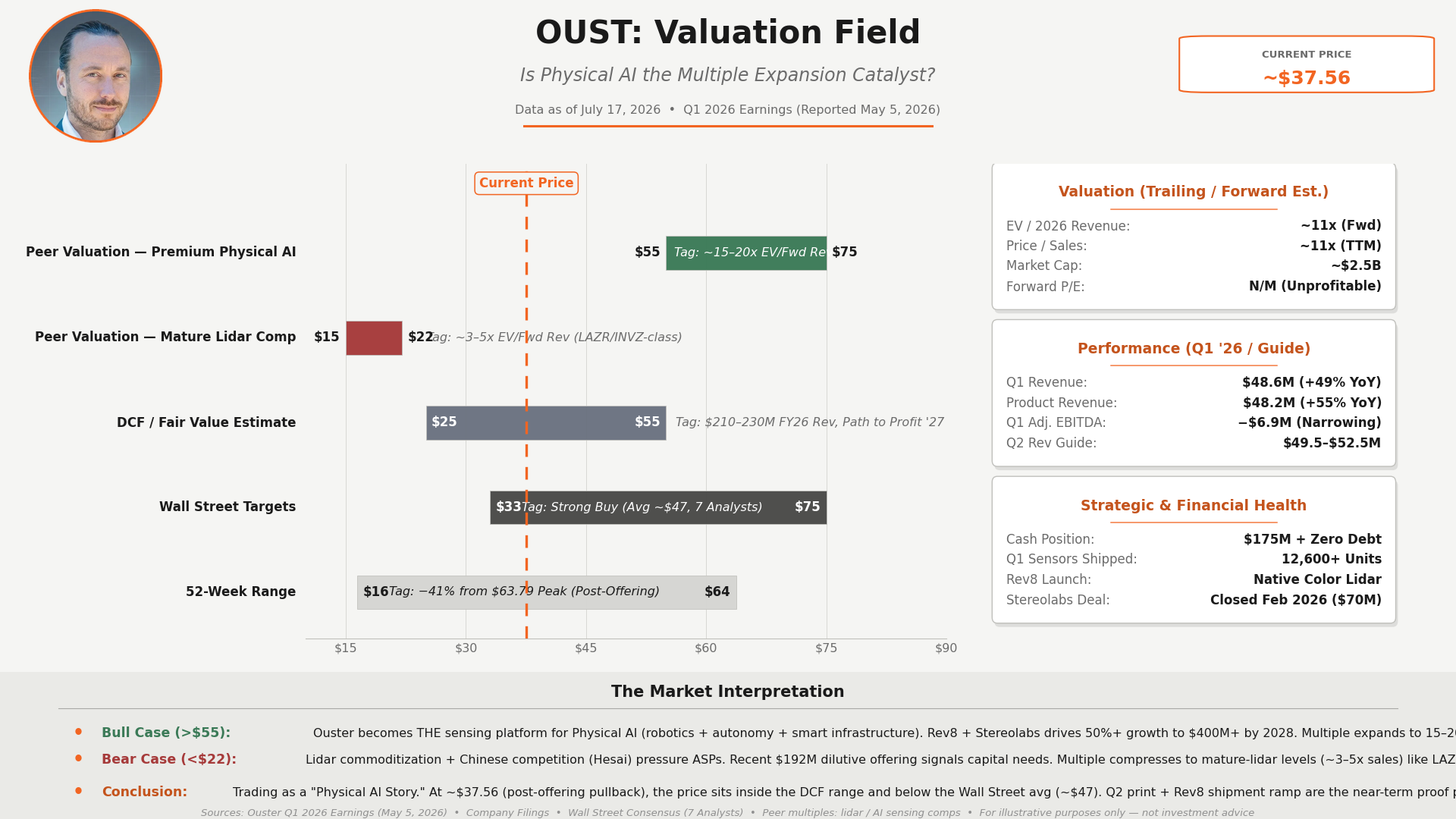
Forward Guidance: The Near-Term Horizon
Q2 2026 Targets: For the upcoming second quarter of 2026, management issued total revenue guidance of $49.5 million to $52.5 million. At the midpoint ($51 million), this signals a continued sequential rise and maintains a 48% year-over-year growth pace.
The Three Profitability Pillars: To convince investors that a breakeven milestone is within reach, management outlined explicit long-term operational targets:
Maintaining 30% to 50% annual revenue growth.
Defending 35% to 40% GAAP gross margins.
Keeping the growth of GAAP operating expenses capped at less than 5% year-over-year.
The July 2026 Dilution Event
The Balance Sheet Buffer: While Ouster closed Q1 2026 with a comfortable $175 million cash position and zero debt, management took aggressive defensive action to shore up its capital runway.
The Capital Raise: On July 2, 2026, Ouster priced a massive underwritten public offering of 3,621,876 common shares at $55.22 per share, yielding a gross capital injection of roughly $200 million.
The Equity Tax: From a pure corporate survival standpoint, this move is a masterstroke as it completely eliminates bankruptcy or near-term liquidity risk while fully funding the capital-heavy production ramp of the new REV8 family. However, for existing equity holders, this massive capital raise acts as a severe near-term dilution event, forcing shareholders to absorb a significant structural hit to their fractional ownership in exchange for a longer operational runway.
This massive July 2026 dilution event perfectly captures the central paradox of Ouster: a business executing phenomenally well on its technological and regulatory roadmap, yet one that remains a public-market capital consumer. With a freshly fortified $375 million cash stack, bankruptcy is off the table, and the runway is clear for the REV8 silicon rollout. But as a long-term investor, you cannot buy a stock based on a compelling narrative or a clean balance sheet alone; you must buy it based on the cold, hard reality of forward-looking cash flows and risk-adjusted probabilities.
Now that we have dismantled the technology, the geopolitical tailwinds, the organizational psychology, and the raw financials, it’s time to find out what this business is actually worth.
