Applied Optoelectronics Deep Dive
Unlocking Layer 7 of the AI Buildout

If you’ve read my last two articles on Poet Technologies and Ouster, Inc., you’ll notice there’s a theme… optoelectronics. For anyone tracking the AI build-out, you’re aware that high-speed data paths are hitting a physical “copper wall.” Scaling next-gen AI clusters requires a shift to optical interconnects, whether through high-density “pluggables,” Linear Pluggable Optics (LPO), or eventually Co-Packaged Optics (CPO).
In this week’s article I’ll be covering an inflection point for Applied Optoelectronics that has been thirty years in the making.
Applied Optoelectronics recently broke ground on a 400,000-square-foot mega-expansion in Pearland Texas. With a state grant of $20.9 million, the company is now constructing one of the largest domestic production facilities in North America for both 800G & 1.6G optical transceivers. This is what enables AI GPUs to send information back and forth to each other without exploding from overheating. Forget what you’ve been hearing about “needing more compute.” Light is where the next bottleneck is forming and AOI owns one of the only USA-based factories capable of growing the laser crystals that is of the utmost importance for the next generation of AI.
Origin Story
The Applied Optoelectronics story is unique, as it began in a cleanroom lab at the University of Houston in 1997, not a garage in Silicon Valley.
As we dive into why AOI matters to the AI infrastructure boom today, we’ll need to first better understand the specific, hyper-technical bet its founder made nearly thirty years ago and how this decision makes the company wildly important in the AI race.
In the late 1990s, the early commercial internet was exploding, and the race was on to build the physical backbone of the web. During this time, most component makers focused their procurement efforts on cheap, standard silicon or gallium arsenide chips.
A brilliant research professor, named Dr. Thompson Lin, who specialized in advanced semiconductor materials, saw a physical limitation coming. He knew that in order to transmit large amounts of data over long distances without the signal degrading or overheating, you needed a very specific material: Indium Phosphide (InP).
Dr. Lin founded AOI with a clear vision of mastering Molecular Beam Epitaxy (MBE), a highly complex process of growing atomic layer upon atomic layer of InP crystals to manufacture proprietary semiconductor lasers.
Why This Mattered Then and Why it is so Important Now
InP is notoriously difficult and expensive to work with and requires extreme precision to fabricate, but it possesses superior electron velocity and thermal properties compared to silicon.
Instead of operating as an asset-light design house that outsourced its chips to overseas foundries, Dr. Lin decided to vertically integrate everything from day one. AOI would design the lasers, grow the raw crystals in their own reactors, fabricate the laser chips, and package them into completed optical transceivers entirely in-house. No small feat!
This exact 1997 bet on specialized InP laser fabrication and vertical integration is what preserves AOI’s relevance today. The same technology used to power fiber-optic internet lines in the 2000s is the same architecture required to build 800G and 1.6T transceivers, the irreplaceable hardware keeping modern AI GPU clusters from choking on data bottlenecks.
By keeping the expensive, complex crystal-growing process inside their own walls for three decades, AOI built an intellectual property fortress that is difficult for new competitors to replicate.
History
The 2017 Golden Era
Applied Optoelectronics was the king of the optical networking sector. This was because of their exclusive, high-volume relationship with Amazon Web Services (AWS) to supply 100G data center transceivers. Around this time, AOI’s stock had an eye-popping rally, soaring from under $10/share in 2016 to over $100 per share in 2017. Their high gross margins and the seamless efficiency of their vertically integrated model was very appealing for investors. For that brief moment in history, the team at AOI was living the high life, but the party wouldn’t last long.
The Hyperscale Cliff
The company’s short-lived rise to fame was followed by an equally dramatic fall from grace when hyperscalers like Amazon diversified its supplier base to lower-cost Chinese component manufacturers. When companies like Innolight Technology entered the market and undercut AOI on price. This triggered a brutal margin squeeze and as transceiver prices collapsed. Amazon cancelled most of their orders, and AOI’s revenue plummeted. Over the following decade the company experienced a painful, multi-year stock price drop that tanked to below 95% of its peak price. Here the company’s stock was considered “dead money” for nearly a decade.
The “Penny Stock” Bottom
By mid-2022 and early 2023, AOI had become a forgotten “penny stock,” and bottomed out around $1.50 per share with fears of delisting. Management was urged by Wall Street to sell off their capital-intensive Texas semiconductor foundries, pivot to a low-cost overseas model, or merge with a larger competitor in order to survive.
This is one of those rare instances where a combination of stubbornness and dedication actually worked out, because Dr. Thompson Lin refused. For years, AOI absorbed heavy operational losses while quietly reworked its fabs in Sugar Land and Pearland to master InP laser design for next-generation 800G and 1.6T architectures. Dr. Lin’s vision to make a decade-long high-stakes gamble is the reason they are now more relevant than ever. He knew that the market would eventually need domestic, ultra-high-speed laser manufacturing again. I don’t think even he could have realized how right he would eventually be when he made this bet.
The 2025–2026 Rebirth
After decades of work, we’re finally beginning to see that a gamble he made decades ago finally start to pay off. In the AI race of the 2020s, generative AI models are scaling so fast that “AI-fatigue” has become a phrase being used in Teams chats across the corporate world. And now… tech giants are about to hit a wall as standard copper wiring and older 400G transceivers won’t be able to move data fast enough between GPU clusters. The bottleneck has shifted from raw compute to optical bandwidth.
Hyperscalers scrambled to secure high-speed optics, and AOI’s lost decade was in the past. By late 2025 and throughout 2026, AOI transformed from a forgotten legacy supplier into an essential AI hardware provider. These commitments had brought the company back to life. This includes over $324 million in disclosed 800G and 1.6T orders from tier-one hyperscalers, like AWS who came crawling back after a decade. Now the stock has staged more than a 10x turnaround from its April 2025 lows, proving that holding onto their physical laser fabs was the most brilliant move in the company’s history. Had they listened to Wall Street’s suggestion to sell off their foundry, they would have remained a technological relic of the past.
Why AOI is Vital for Today’s AI Economy
The Bottom Line: Nvidia builds the brains (GPUs), but Applied Optoelectronics builds the nervous system that provides the synapses with their spark.
The typical AI cluster is made up of thousands of GPUs that must function as a single, synchronized supercomputer. If the optical transceivers connecting those chips overheat, drop packets, or introduce latency, a $500 million AI training cluster grinds to a halt!
Because AOI controls its own Indium Phosphide (InP) crystal growth inside the United States, they offer hyperscalers two things that no other company can match:
Supply Chain Autonomy: They don’t have to wait in line at third-party Asian foundries to grow their laser wafers.
Geopolitical De-risking: As U.S. tech giants actively move their AI supply chains away from foreign geopolitical flashpoints, AOI’s heavily expanded Texas manufacturing footprint makes them one of the very few domestic suppliers for the physical AI layer.
The Business: What They Do
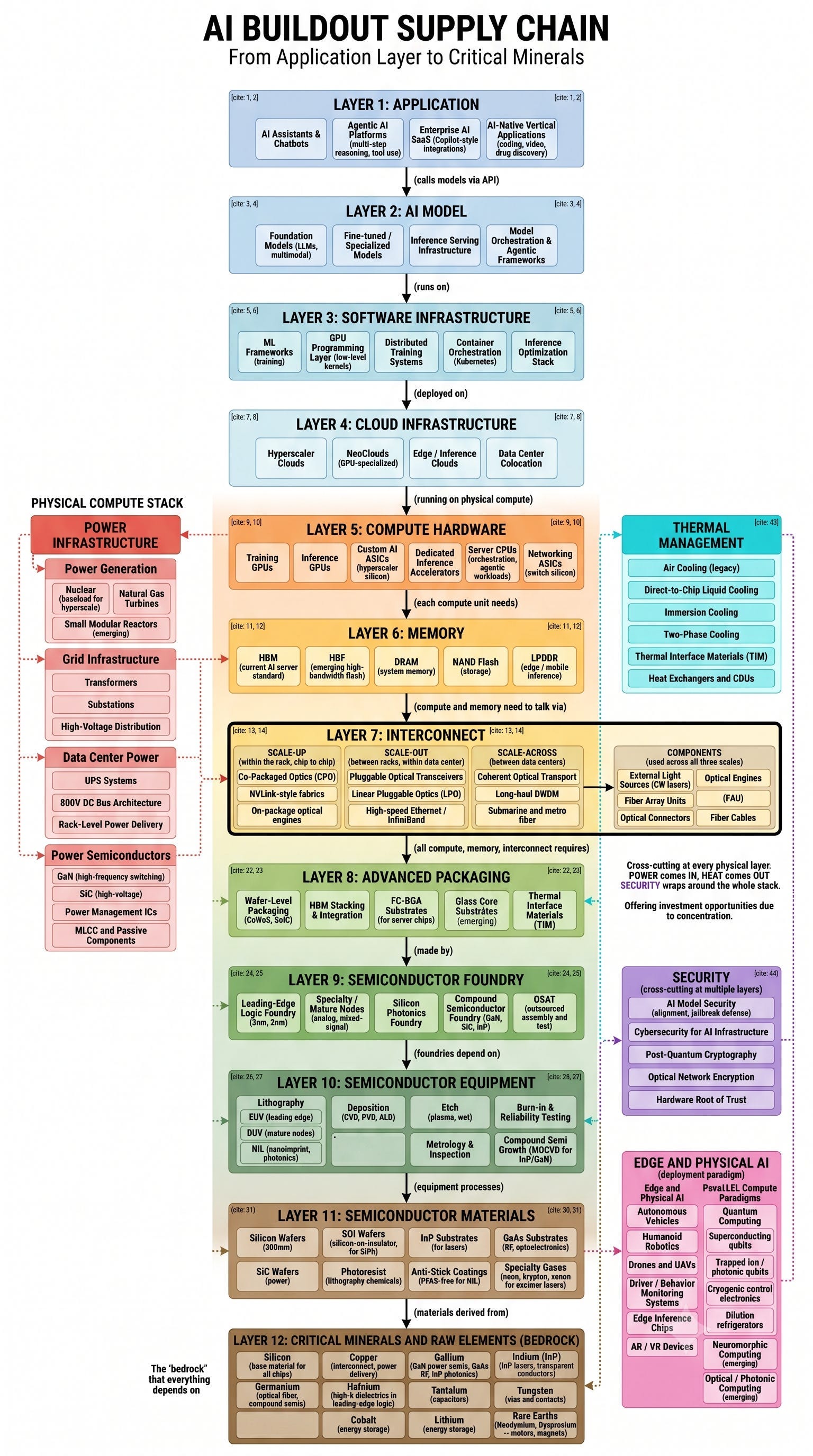
To understand the business behind Applied Optoelectronics, we have to look at where they sit in the 12-Layer AI Buildout Supply Chain.
AOI operates in Layer 7: Optical Interconnects & Networking.
While Layer 5 (Nvidia/AMD GPUs) get the vast majority of the buzz in tech news today, compute is utterly useless if their chips can’t sync up in real time. As cluster sizes expand into tens of thousands of Nvidia’s Blackwell & AMD’s MI350X GPUs, copper wiring is about to hit a wall. In Layer 7, AOI’s products translate electrical signals from the GPU into light pulses via optical transceivers. This sends data through fiber lines at the speed of light with almost zero latency. Seeing as how nothing is faster than the speed of light… light becomes the obvious choice when it comes to speed.
Without this light layer, GPU mega-clusters would eventually collapse due to data traffic jams. So yes, this will become a must-have for the next generation of AI clusters.
Data Center Transceivers (The Core Engine)
The company builds pluggable optical transceivers. These are the central value driver for AOI and are the physical modules inserted directly into data center switches and server racks.
Each transceiver takes electrical data streams from a GPU node, converts them into light via internal semiconductor lasers and then sends that light across their fiber optics which translates it back to electricity at the receiving end.
A single modern AI super-cluster requires hundreds of thousands of these transceivers and since the AI buildout of the 21st century is showing no signs of stopping, we can expect that number to increase over the coming years.
The Upgrade in Speed: Scaling to 800G & 1.6T
Bandwidth capacity is how transceivers are rated and AOI is phasing out its legacy, lower-margin 100G/400G modules and are now shifting their focus on ultra-high-speed platforms that will serve as the future nervous system of the AI economy:
800G Modules: These are the current backbone for active AI cluster deployments and AOI is ramping up volume in its Texas fabs to meet hyperscaler demand. Welcome back, Amazon!
1.6T Modules: Moving to 1.6 Terabits per second requires double the density and AOI’s proprietary InP continuous-wave (CW) lasers have a competitive advantage in power efficiency and heat dissipation. As of today, we’re seeing the initial volume ramps for this next-gen tech. In 2027 1.6T are expected to overtake 800G as the primary speed tier for hyperscaler deployments. By 2028 it will become the industry standard before 3.2T CPOs enter qualification.
Broadband / CATV (The Cash-Flow Bedrock)
AI optics represent the explosive upside, but AOI’s legacy Cable TV and broadband business support the business as a self-funding stabilizer as they scale for the next generation of the AI buildout.
The Driver: Cable and telecom operators are rapidly upgrading their hybrid fiber-coaxial (HFC) networks to DOCSIS 4.0 standards to offer multi-gigabit home internet.
The Products: AOI supplies them with the high-margin components required for these nationwide infrastructure upgrades. This gives them a reliable base-load cash flow to support their AI capital expenditure ramps. Shout-out to Spectrum, Xfinity, and the other cable companies across North America for the reliable cash flow!
The Thesis
The Applied Optoelectronics thesis relies on the assumption that the AI bottleneck will be migrating from compute to interconnects. Luckily for AOI, they sit at the intersection of power efficiency and domestic supply security.
Part 1: The AI Optical Bottleneck
Most network traffic moves from the server to the user in traditional cloud computing. However, when it comes to generative AI clusters, over 90% of traffic is moving back and forth from GPU to GPU.
When training frontier models across tens of thousands of GPUs, the cluster can only act as fast as the slowest node. During multi-GPU synchronization steps thousands of processors need to pause as they “wait” for parameters to pass through the network fabric. This causes a delay of maybe a few seconds… which creates a poor experience for the impatient users of today that are used to lightning-fast responses. How spoiled we’ve become.
At 800G and 1.6T speeds, standard copper wiring degrades data within just 1–2 meters and optical interconnects become mandatory in order to handle the next generation of AI builds. If an optical transceiver overheats or drops packets, a half-billion-dollar GPU cluster sits idle, and nobody wants their top-performing employee to slack off!
Part 2: The LPO (Linear Pluggable Optics) Pivot
Historically, every optical transceiver module had a heavy Digital Signal Processor (DSP) chip to re-time, clean, and amplify electrical signals. But now, as modules scale to 800G and 1.6T, traditional DSPs have created two problems: excessive power consumption (higher costs) and added latency (more waiting). For a data center with 100,000+ optical links, DSPs alone can consume megawatts of wasted energy. Surely this is what the hippies protesting against new datacenter builds are most concerned about.
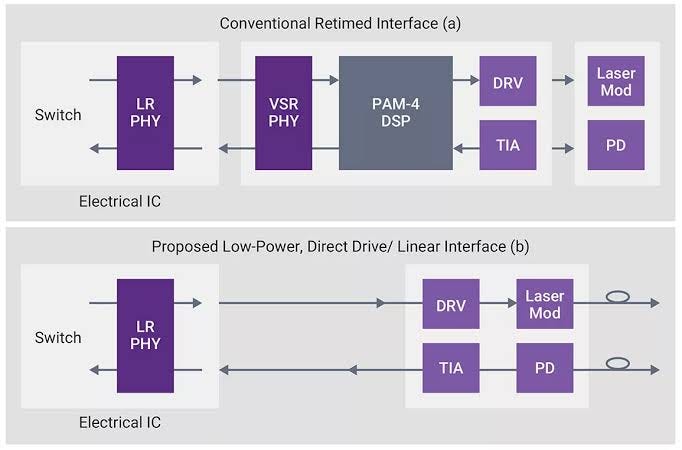
This is where Linear Pluggable Optics (LPO) come in. The LPO architecture removes the power-hungry DSP from the transceiver module which drives the optical components directly from the main switch ASIC (Application-Specific Integrated Circuit). See the below chart that compares traditional DSP to LPO and you’ll notice a ton of savings in power, cost, noise and latency. This creates a win-win-win-win scenario for LPOs.
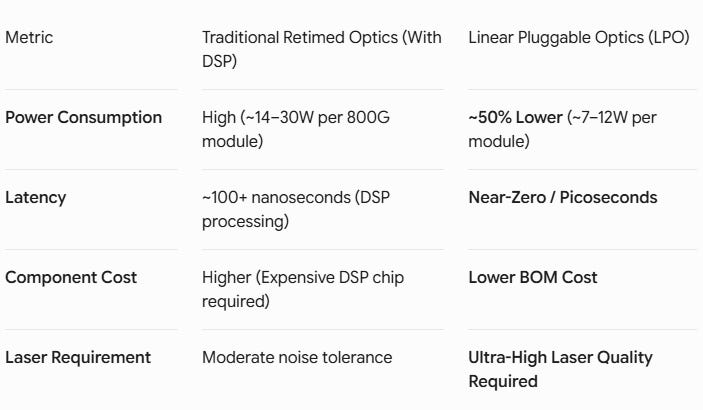
Why LPO favors AOI: Removing the DSP means there is nothing inside the transceiver to clean up a distorted optical signal. The laser chip itself must generate an impeccably clean, low-noise, highly linear light pulse. Since AOI grows its own Indium Phosphide (InP) lasers in-house, they can easily tailor chip quality to strict LPO tolerances. This is something that asset-light module packagers struggle to achieve with off-the-shelf lasers.
Part 3: The Domestic Onshoring Premium
The vast majority of global transceiver manufacturing and packaging currently happens in China and Southeast Asia. Luckily for AOI, North American hyperscalers face mounting geopolitical pressure as concerns about potential tariff risks, and national security come into play. Companies are now highly incentivized to find American-made sources for their physical AI infrastructure.
AOI’s capacity expansion in Sugar Land and Pearland, Texas gives them several competitive advantages:
Tariff & Sanction Shielding: A U.S. manufacturing pipeline protects North American hyperscalers from trade disruptions.
Co-Location with US Tech Giants: Direct proximity to major U.S. cloud providers allows for faster custom production cycles and tighter joint engineering feedback loops.
Government Support: Backed by Texas semiconductor grants, AOI can offer tier-one customers a fully domestic, onshore option for AI connectivity.
Gannon Capital Neurodivergent Thoughts:
All signs point to a sharp pivot to optics in late 2027 for the ongoing AI buildout.
For nearly a decade, Wall Street analysts wanted AOI to ditch its expensive Texas laser fabs and just buy cheap off-the-shelf parts like everyone else. Dr. Thompson Lin essentially said “no thanks” and kept growing Indium Phosphide crystals in Sugar Land while the stock traded for less than the cost of an elementary school kid’s lunch money.
Fast forward to where we are now: as the AI buildout charges toward late 2028, the entire industry is hitting a wall on power consumption. Running traditional DSP chips in every single transceiver is the data center equivalent of leaving thousands of hair dryers running inside the racks 24/7. Linear Pluggable Optics (LPO) strip that power-hungry chip out completely, cutting energy draw nearly in half… but there’s a catch!
Without a DSP to clean up the signal, the laser itself has to be practically flawless.
Turns out, clinging to a stubborn, capital-heavy crystal foundry wasn’t a bad idea after all, it was just a decade too early. As hyperscalers make their forced pivot to optics, AOI is standing at the tollbooth with the exact onshore laser capacity everyone suddenly needs.
The Competition
When I look at AOI’s competitive landscape, I don’t care about random hardware start-ups. What concerns me as a potential investor are three tiers of competitors who want to eat AOI’s lunch by leveraging their tech to eliminating the need for pluggable transceivers altogether.
Before considering an investment in $AOI, these are the threats that I very strongly feel need further consideration.
The Silicon Giants
Broadcom ( AVGO 0.00%↑) & Marvell Technology (MRVL 0.00%↑)
These are the heavyweights that are dictating how data moves on today’s semiconductors and their power rests in their architecture and manufacturing volume.
Broadcom’s CPO Threat: Broadcom is pushing heavily into Co-Packaged Optics (CPO). If hyperscalers abandon pluggable modules in top-tier switches for CPO then AOI’s pluggables have a much higher chance of becoming defunct.
Marvell’s DSP Threat: Marvell owns the high-end DSP market and if they slash DSP power consumption faster than the industry adopts DSP-less LPO (Linear Pluggable Optics), AOI’s position as the best product for energy savings goes out the window.
The Laser Heavyweights
Coherent Corp (COHR 0.00%↑) & Lumentum (LITE 0.00%↑)
Coherent and Lumentum are the main contenders that threaten AOI at the physics layer.
Coherent’s Scale Advantage: Coherent operates the world’s first 6-inch (150mm) Indium Phosphide wafer fab right down the road from AOI in Sherman, Texas. The fact that they manufacture larger wafers means that they can pack significantly more laser chips per run and lower costs per unit. That paired with manufacturing scale and their longstanding 20-year partnership with Nvidia, and Coherent possesses an advantage in this specific layer of the AI race.
Lumentum’s Merchant Laser Model: Lumentum supplies external continuous-wave lasers to silicon photonics packagers. So… if cloud giants decide to buy silicon photonics engines powered by Lumentum lasers rather than fully integrated modules, AOI will certainly lose volume.
The Low-Cost Asian Competitor
Zhongji Innolight
In an unregulated free market, Chinese optical giant Zhongji Innolight would absolutely crush most American competition.
Innolight owns over 20% of the global datacom optics market share and have massive scale, incredible yields, and lower labor assembly costs. In an open bidding war for European or Asian data centers, Innolight would easily undercut AOI on price. This is why it is so important for AOI needs to win in the American market.
The Geopolitical Shield: The only reason that Innolight isn’t crushing AOI in the US is Uncle Sam.
Strict U.S. technology export controls, tariffs, and national security directives prevent North American hyperscalers from sourcing their primary AI cluster materials from overseas supply chains. Innolight wins on price and scale, but AOI has the Texas zip code, and in the AI build-out race, domestic security trumps raw unit economics.
BlackRock Enters the Chat
Just last week, news came out that BlackRock is backing the Innolight listing on Hong Kong’s stock exchange. This is the largest listing in seven years and is a landmark event for the AI supply chain. This listing will supply Innolight with a $7B capital injection to use for R&D, expansion and supply chain resilience. The greatest defense against this behemoth for AOI are tariffs.
Gannon Capital Neurodivergent Thoughts:
The competitive landscape for optics seems worrisome at first for AOI. This is a company that has already had a multi-year near-death scenario and has only recently come back to life, ready to steal market share from some of the titans of the industry. What I’ve realized is that they don’t need to conquer the entire optics universe to deliver massive returns. Boardcom can keep their ASIC crown, and Coherent can run the high-volume catalog. AOI’s play s to be the hyper-focused donestic laser specialist that cloud giants and hyperscalers have on speed dial for customer InP engines to bypass power-hungry DSPs and hedge against foreign supply chains. The AI buildout is massive and we don’t need to own the whole thing to win. Think of this as the tollbooth on the one bridge that every hyperscaler will need to cross at some point over the coming years.
The Moat
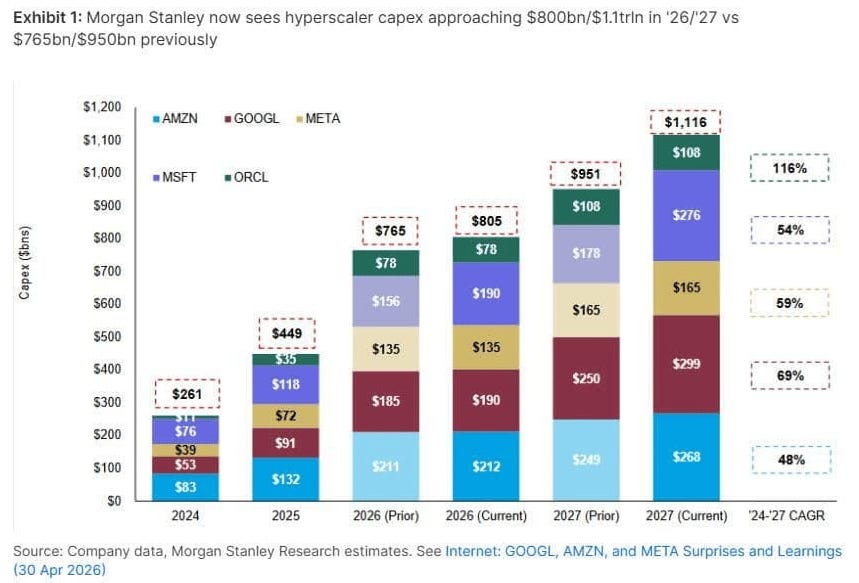
When I think about what keeps AOI from getting crushed by semiconductor giants, I keep coming back to the physics… and a ridiculous amount of CapEx that they have spent over the past few decades. Not to mention that it is expected to surpass $1T by 2027 and continue to increase into the early 2030s.
AOI has three physical advantages that takes billions of dollars and decades of focused work in order to replicate. AOI builds their own InP lasers in-house from scratch and have been doing so since the company began. Only a small, elite group of vertically integrated companies possess the capabilities to handle the entire manufacturing process and AOI is one of them.
This gives them three major advantages:
Instant Design-to-Production Loops: If a hyperscaler needs a custom laser configuration, they’re able to tweak the wafer growth process in their own fab to produce tailor-made lasers for their customers.
Margins: By producing them in-house, they don’t need to worry about a 50% markup from a middleman.
Precision Signals: By owning the foundry, they are capable of hitting the tight tolerances that LPO architecture requires.
A Quarter Century of Focus
AOI has spent over two decades accumulating the IP around laser chemistry, thermal dissipation and long-term liability. This hard-earned knowledge and experience are a reflection of the physical yields of their Texas fabs.
The Texas Fabs
In recent years, the risk of relying on a single overseas supply chain is viewed by the market as operational suicide. To survive, the semiconductor industry needs a back-up… and a back-up for their back-up.
AOI’s location in Sugar Land & Pearland, Texas is a huge geopolitical edge that a cheaper Asian competitor will never be able to offer.
With the hyperscaler CapEx spend expected to exceed over $1 trillion in 2027, having a tier-one supplier whose lasers are grown and packaged inside Texas is an excellent insurance policy that is worth paying a premium for.
Strategic Partnerships & Alliances
AOI is no longer just an opportunistic component supplier pitching hardware on price. They are locking themselves into multi-hundred-million-dollar supply commitments with cloud giants, cable operators, and state governments.
To see where their future revenue is expected to come from, you need only look at their core alliances.
The Hyperscale Cloud Backlog ($324M+ Disclosed Pipeline)
For years, Wall Street’s main knock on AOI was customer concentration and order volatility. Now in 2026, the narrative has changed from “will they win designs?” to “how fast can they ship?
The Customer Order Surge: Between March and April 2026, a single primary hyperscale customer, most likely Microsoft, dropped a $200M+ order for 1.6T transceivers. This was immediately followed by $124 million in cumulative 800G orders ($53M initial order + a $71M upsized follow-on). That’s over $324 million in backlog from a single cloud account. If other hyperscalers join the party, the stock will likely experience another violent upward re-rating.
Diversification in Motion: While “Customer A,” (probably Microsoft), dominates the headline numbers, AOI quietly completed its first 10,000-unit shipment of 800G single-mode transceivers to a second tier-one hyperscale customer in Q1 2026 (probably Amazon’s AWS).
The Microsoft & LPO Connection: Microsoft’s push into Linear Pluggable Optics (LPO) aligns directly with AOI’s custom laser capabilities. By stripping out the power-hungry DSP chip, Microsoft gets cooler racks, and AOI gets a sticky architectural partner.
Government Backing
On April 29, 2026, Texas Governor Greg Abbott announced a $20.8 million grant awarded to AOI from the Texas Semiconductor Innovation Fund (TSIF).
State grants don’t usually make or break an investment thesis, but it sure doesn’t hurt. Also, context matters here:
The $279M Expansion: The state check subsidizes about 7.5% of the $279 million buildout in Sugar Land, Texas. AOI is adding a 210,000-square-foot manufacturing facility right next to its current headquarters.
Scaling Onshore Volume: This expansion is designed to build the largest domestic production capacity for AI-focused transceivers in the U.S.
Target Capacity: AOI is targeting an ambitious 800G production ramp that aims to produce over 100,000 units per month by year-end, with roughly 40% of total production physically manufactured on U.S. soil.
Hyperscalers have been facing strict federal directives to de-risk their Asian supply chains, so a state-subsidized Texas cleanroom gives them an advantage over competitors.
The Cash-Flow Bedrock: Charter, Mediacom & Digicomm
AI optics are the clear growth engine for the foreseeable future and are the reason for the recent hype. However, AOI’s legacy Broadband and Cable (CATV) segment provides the high-margin baseline cash flow that keeps the lights on while fabs scale up. This provides the company with some safety throughout its evolution into the synapse of the AI buildout.
The Numbers
AOI’s income statement prior to 2026 was mostly a cash-burning mess that investors had little to no interest in. It was CapEx-heavy, had low gross margins, and consistent net-income losses while continuing to fund their laser fabs whose demand had not yet caught up to their vision.
This all changed in Q1, 2026.
Revenue Acceleration: Crossing the $1.1B Threshold
For a company that spent years churning out a mere $200M–$250M in annual revenue, AOI’s new trajectory shows a drastic positive change:
Q2 2026 Revenue Guidance of $180M to $198M was a huge leap driven by the initial volume rollout of 800G optics. For comparison, this uptick is almost double their Q2 2025 revenue print of $103M.
Full-Year 2026 Target: Management raised full-year guidance to exceed $1.1 Billion in revenue (up 141% YoY).
The Revenue Staging: In Q2, 800G shipments will finally hit the P&L in volume, and Q3 will mark the beginning of commercial shipments for $200M+ 1.6T hyperscaler order mentioned earlier.
Important note: In 2025, roughly 54% of their revenue came from Cable TV & Broadband customers and only 43% came from data centers. Over the coming years we’ll see a dramatic shift of their revenue profile. This is beneficial for AOI because the specialized engineering required for high-frequency lasers for advanced data center optics carry a richer gross margin.
The Pearland Capacity Ramp (400,000 Sq. Ft. Expansion)
In order to sell $1.1B worth of high-speed optics, they’ll need the cleanroom floor space to package them.
Earlier this month, AOI broke ground on its Pearland, Texas manufacturing campus, adding nearly 400,000 square feet of additional manufacturing space across two adjacent properties.
By scaling monthly transceiver output by 6x to 7x, AOI is expanding the physical footprint needed to satisfy a supply-constrained optical market through mid-2027.
Turnaround to Profitability
Top-line growth doesn’t matter to the intelligent investor if a large percent of it doesn’t drop to the bottom line. AOI is digging themselves out of multi-year deep net losses toward profitability. For context, AOI has only been profitable only 4 out of the past 20 years, with their most recent profitable year being nearly a decade ago in 2017. We’re finally beginning to see a turnaround as their full-year 2026 non-GAAP operating income is currently projected to clear $140 million. Not bad for a company that has been slowly bleeding money for decades.
Because AOI owns its internal laser fabs, every incremental 800G or 1.6T module shipped past break-even carries much needed operating leverage, so that margin expansion accelerates as Pearland ramps to full scale.
Forward Guidance: What to Watch Through 2027
If you’re tracking AAOI 0.00%↑ as the AI buildout pivots to photonics, here are the core catalysts and operational milestones that dictate whether the stock continues to re-rate higher:
Q3/Q4 1.6T Qualification & Delivery: Execution updates on the $200M+ 1.6T master order are key signals of success for the company’s evolution. Shifting 1.6T modules from lab sampling into full production by late 2026 is the ultimate operational test of their Pearland expansion.
The 6-Inch Wafer Upgrade (The Margin Driver): AOI is actively upgrading their Indium Phosphide laser fabs from legacy 4-inch wafers to 6-inch (150mm) wafers. This will increase laser chip yields per wafer by over 2x, driving down unit costs and pushing gross margins higher for the company. This is a necessary move to be able to compete with industry behemoths like Coherent & Lumentum who have already deployed their 6-inch Indium Phosphide platforms to slash costs. It appears that in the photonics industry, size does matter.
Secondary Hyperscaler Conversions: We already know that “secret” Customer A (almost certainly Microsoft) and Customer B (most likely AWS) are locked in. The next leg of growth depends on whether secondary lab qualifications, with other cloud giants like Meta, Alphabet, Oracle and even potentially xAI, convert into formal multi-hundred-million-dollar contracts.
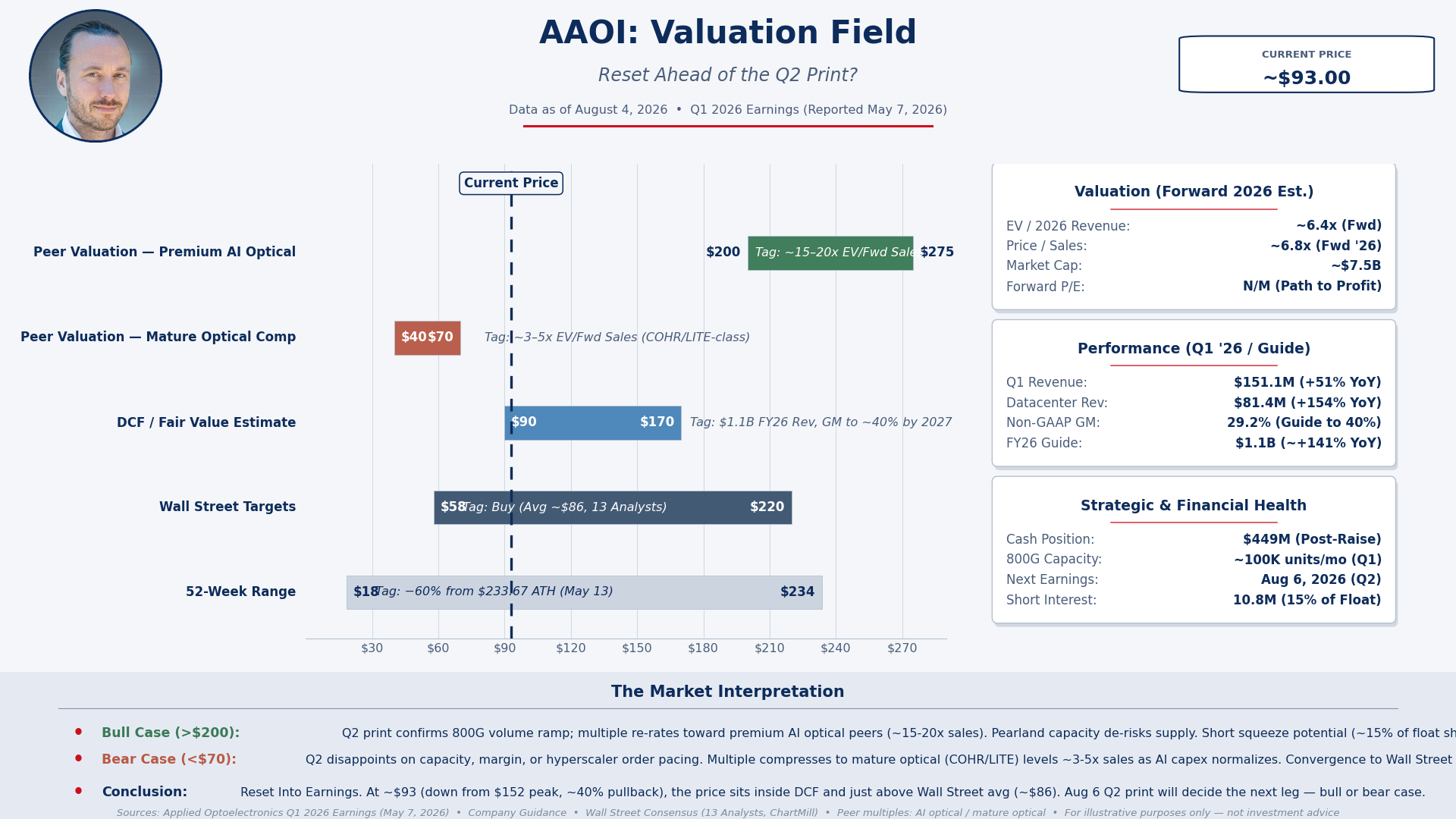
On paper, Dr. Thompson Lin’s 30-year bet on Indium Phosphide is one of the most brilliant long-term plays in modern tech history. AOI has the Texas factories, the $324M+ backlog, and the laser fabs that hyperscalers suddenly need.
The question that I keep coming back to is this: Is AAOI 0.00%↑ still an asymmetric risk/reward play at these levels, or is it setting up for a potential optics capex pause?
Below the paywall, we dive into the final piece of the thesis:
The Execution Risk: What happens to gross margins if Pearland’s 400k sq. ft. expansion hits semiconductor yield hiccups or cleanroom delays?
The Scenario Matrix (Bear vs. Base vs. Bull): My probability-weighted price targets ranging from a return to cyclical low-margin optics in the bear case, up to a national security asset re-rating in the bull case.
The CPO & 3.2T Roadmap: What needs to happen for AOI to evolve from a pluggable transceiver maker into a permanent American-made national security asset.
My Personal Playbook: My allocation, risk management rules, and whether or not I’m considering a position in AAOI 0.00%↑.
Let’s dive in!
